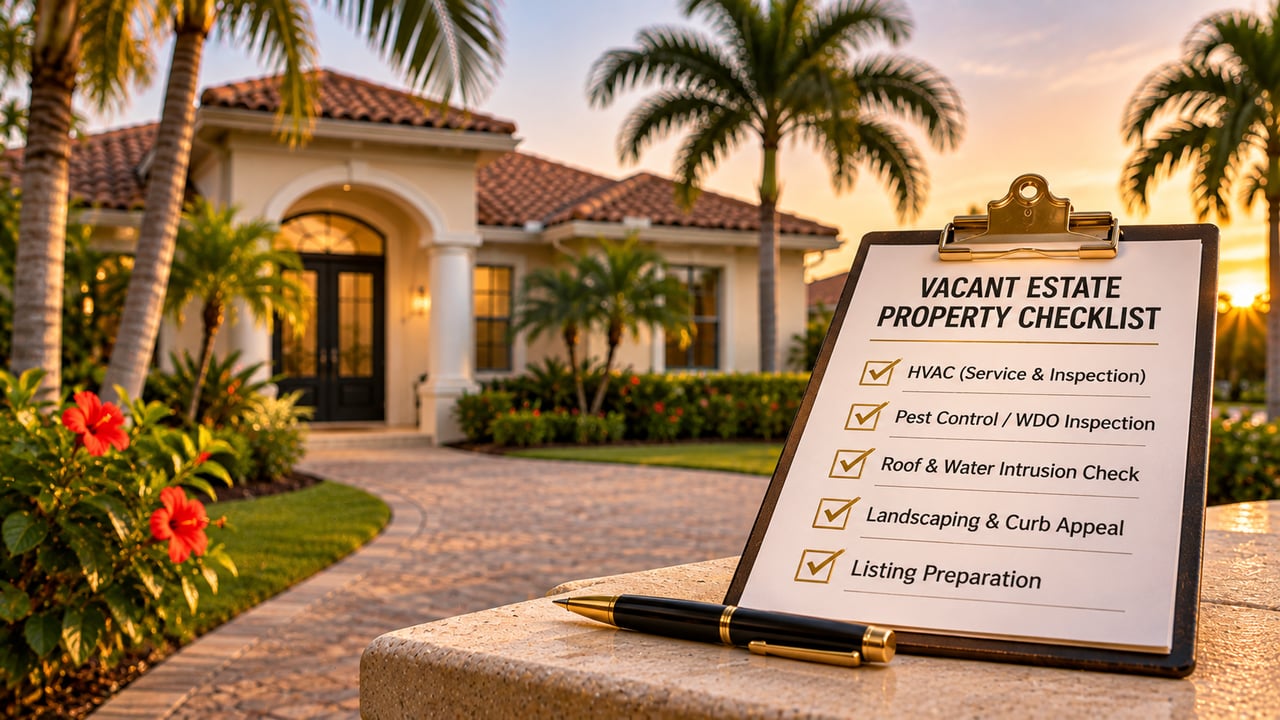
A vacant inherited property in SWFL needs specific attention before it’s ready for the market — and the Florida climate is not forgiving of neglect. Personal representatives who understand what buyers in this market expect, and what condition issues have the biggest impact on sale price, make better decisions about where to invest pre-listing and where to skip the expense.
Important: This post reflects my experience as a real estate professional working with estate sales in Southwest Florida. It is not legal advice and is not a substitute for a licensed Florida probate attorney. The authority of a personal representative to spend estate funds on property preparation, and what expenditures may need court approval, are legal questions your attorney must address. Please consult qualified legal counsel before making decisions about estate property expenses.
Why Vacant Properties in SWFL Are a Specific Challenge
A vacant home anywhere needs attention. A vacant home in Southwest Florida needs it faster.
The combination of heat, humidity, salt air proximity, and Florida’s pest environment creates conditions that accelerate the deterioration of an unoccupied property in ways that buyers from cooler climates don’t always anticipate. What looks fine on a drive-by can have significant undisclosed issues by the time a buyer’s inspector walks through.
The personal representative’s job is to get the best possible outcome for the estate — which means delivering the property to buyers in the condition that supports fair market value, not in the condition that reflects months of vacancy. Understanding what matters most in SWFL’s market conditions helps focus pre-listing spending where it has the highest return.
Your probate attorney will advise on what property expenses can be paid from estate funds and whether any expenditures above a certain threshold require court approval. That’s the legal side. This post covers the real estate side.
The SWFL Climate Issues That Matter Most for Vacant Properties
Air conditioning. This is the most important one. In Florida, HVAC systems are not seasonal equipment — they run year-round, and they need to run in a vacant home to control humidity. A vacant home where the AC has been shut off, set too high, or has failed without anyone noticing can develop mold within weeks during SWFL’s summer months. Mold is a material defect that must be disclosed, requires remediation, and significantly affects buyer perception and sale price.
Before listing, an HVAC system in an estate property should be serviced and inspected by a licensed contractor. Proof of recent service is a simple, low-cost item that removes a buyer concern before it starts.
Pest control. Florida has termites, carpenter ants, and other wood-destroying organisms that treat vacant homes as an invitation. A WDO (wood-destroying organism) inspection is a standard buyer requirement in SWFL closings, and discovering an active infestation during the buyer’s inspection process is exactly the scenario you want to avoid. An active pest control contract on the property during the listing period — and a recent WDO inspection — signals to buyers that the property has been maintained.
Water intrusion. Florida’s rainy season runs roughly June through September. A vacant property with any roof, window, or door integrity issue is vulnerable. A water intrusion that goes undetected for weeks can cause damage that far exceeds what a repair would have cost. A visual inspection of the roof, gutters, windows, and exterior before listing — and before SWFL storm season, if timing allows — is worth the cost.
Landscaping. SWFL landscaping grows fast year-round. A property that’s been vacant for months often has landscaping that signals neglect to buyers and may trigger HOA violations in a community with landscaping standards. Resetting the landscaping to a presentable baseline before listing is a low-cost item with meaningful impact on first impressions.
The Sell-As-Is vs. Repair Decision
One of the most common questions I hear from personal representatives is: how much should we put into the property before listing?
The honest answer depends on the specific property, its condition, and what the market supports. There is no universal rule, and the sell-as-is decision isn’t always wrong — in some cases, the SWFL market supports as-is sales at competitive prices, particularly for investors who price the needed work into their offers.
What I look at when advising on this decision is the relationship between cost and return. Some items have a direct, positive impact on sale price — things like HVAC service, pest control, fresh landscaping, and cosmetic deferred maintenance that buyers interpret as evidence of neglect. These are almost always worth addressing. Other items — full kitchen renovations, major system replacements, significant structural work — often don’t return their full cost in a sale and may be better handled by pricing the property to reflect condition rather than investing in the work.
A comparative market analysis that shows what comparable properties in similar condition have sold for gives personal representatives a factual basis for this decision. That’s where the conversation should start.
Preparing for the Listing Process Specifically
Beyond physical condition, there are a few listing-specific items that estate properties often need that owner-occupied sales don’t.
Keys and access. A vacant property that multiple people need to access — the listing agent, an appraiser, inspectors, buyers and their agents — needs a reliable access system from the start. A lockbox coordinated with the listing agent and clear authorization protocols keep the process moving.
Utilities. A listing needs utilities active — buyers and inspectors need to operate systems, test outlets, run water, and confirm that everything works. Utilities that have been disconnected need to be restored before the first showing.
Photos that accurately represent the property. Professional photography on a vacant property is different from an occupied home — staging, lighting, and the absence of furniture all affect how the home presents. I work with professional photographers who understand how to present SWFL properties effectively, including vacant ones.
Disclosure. Florida law requires sellers — including personal representatives — to disclose known material defects. For an estate property, this means the personal representative needs to compile what is known about the property’s condition and history. Your probate attorney will advise on the disclosure obligations that apply to estate sales specifically.
Guaranteed Sale Program
If the estate needs to sell within a defined timeline — 60 days or less — ask me about my Guaranteed Sale Program. I’ll sell the property in 60 days, or I’ll waive my commission. This kind of timeline certainty matters for estates that are carrying ongoing costs and need to close the chapter. Details at theabreugroup.com/seller.
Ready to Talk Through an Estate Property in SWFL?
If you’re a personal representative working through what a SWFL estate property needs before it’s ready to list, I’m glad to walk through it with you — no commitment required, just a conversation about condition, timing, and what the market supports.
Call or text: 727.638.1704
Email: [email protected]
Website: theabreugroup.com
— Daniel
This content is for educational purposes only and is not legal advice. Florida probate estates involve legal rights and obligations that a licensed Florida probate attorney must address. Please consult qualified legal counsel before making decisions about estate property.
Frequently Asked Questions
What is the most important thing to check before listing a vacant inherited home in SWFL?
The HVAC system. Florida’s heat and humidity mean that a vacant home where the AC has failed or been shut off can develop mold within weeks during the summer months. Mold is a material defect that must be disclosed and requires remediation — it’s one of the most expensive problems to discover mid-transaction and one of the least expensive to prevent with active maintenance.
Does a personal representative have to fix everything before listing an estate property?
No — and in many cases, spending extensively on repairs doesn’t maximize the estate’s return. The decision should be based on what a CMA shows about comparable sales in similar condition and what the return on specific improvements actually is in the current market. Some items — HVAC service, pest control, landscaping — are almost always worth addressing. Others are better handled by pricing to condition.
What is a WDO inspection and why does it matter for estate sales?
A wood-destroying organism (WDO) inspection assesses whether the property has an active infestation of termites, carpenter ants, or other wood-destroying pests. It’s a standard buyer requirement in SWFL closings, and discovering an active infestation during the buyer’s inspection is a significant negotiating event. Having a recent WDO inspection and an active pest control contract on the property before listing removes a common friction point.
Can estate funds be used to pay for property maintenance and repairs before listing?
Courts and attorneys generally recognize that reasonable property maintenance can be paid from estate funds, but the specific requirements depend on the estate administration and may require documentation or court approval above certain amounts. Your probate attorney will advise on what’s permissible and what records are required.
How should a personal representative handle disclosure for an inherited property they know little about?
Florida law requires disclosure of known material defects — the personal representative must disclose what they know. For an inherited property where the personal representative has limited knowledge of the history, a pre-listing inspection is often the right step: it surfaces what’s there, gives the estate an opportunity to address or price for it, and creates a documented basis for disclosure. Your probate attorney will advise on the disclosure obligations that apply to estate sales specifically.
How does professional photography work for a vacant home?
Vacant properties present differently than occupied ones — furniture anchors scale and suggests lifestyle, and without it, buyers can struggle to visualize a space. Skilled real estate photographers understand how to light and frame vacant spaces effectively. For SWFL luxury properties, some agents also use virtual staging, which digitally adds furniture to listing photos. I use professional photographers who have specific experience with SWFL properties, including vacant estate properties.
What should be done about a vacant property’s HOA compliance before listing?
HOA communities in SWFL have standards — often covering landscaping, exterior maintenance, and appearance — and they enforce them actively. A vacant property that has fallen behind on HOA standards may have outstanding violations or accrued fines that become part of the closing equation. Getting the property into HOA compliance before listing — and resolving any outstanding violations — is cleaner than discovering those issues mid-transaction.