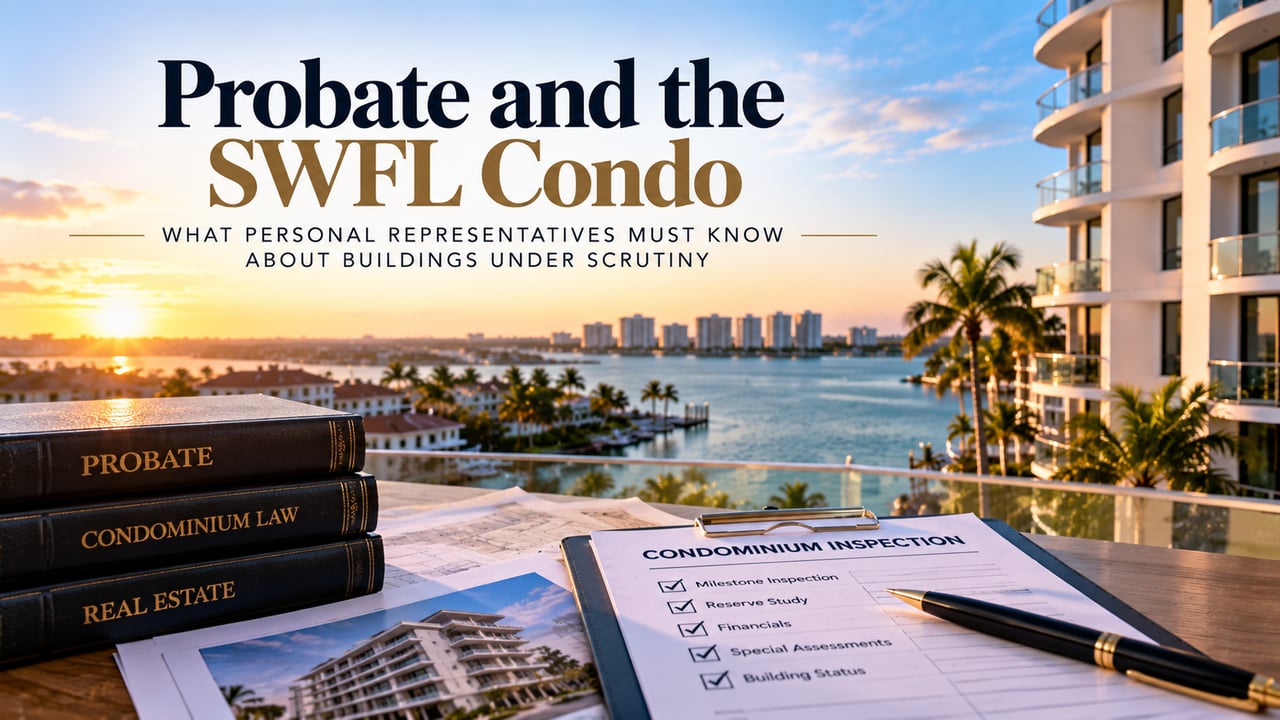
An inherited condo unit in a Southwest Florida building that is facing structural inspections, reserve shortfall assessments, or deferred maintenance issues presents a specific set of probate challenges. Understanding the building's financial and physical status — before listing, not after — is essential for personal representatives who want to protect the estate's value and avoid post-closing complications.
A New Layer of Complexity That Did Not Exist Five Years Ago
Prior to Florida's legislative response to the Surfside condominium collapse in June 2021, a standard SWFL condo probate sale was relatively straightforward: establish legal authority, get the unit appraised, list it, manage the HOA estoppel process at closing, and distribute the proceeds. The building's structural condition and the association's reserve funding were background considerations — important, but not typically front and center.
Florida's SB 4D (2022) and SB 154 (2023) changed that fundamentally. Florida now requires condominium buildings three stories or taller to undergo Milestone Structural Inspections at defined intervals, to conduct Structural Integrity Reserve Studies, and to fund those reserves at levels that reflect the actual cost of future capital repairs. These requirements have surfaced significant deferred maintenance and reserve shortfalls in many SWFL condo buildings — and that reality is now front and center in any condo transaction, including probate sales.
For a personal representative managing an inherited condo in a SWFL building that is working through these requirements, the building's status is not just background information. It is a core determinant of the unit's market value, its insurability, and the buyer pool that will realistically purchase it.
The Building-Level Due Diligence That Personal Representatives Must Complete
The Milestone Inspection Status
Florida now requires Milestone Structural Inspections for condo buildings three stories or higher that are 30 years old or more (25 years for coastal buildings within three miles of the coast). A Phase 1 inspection is a visual examination by a licensed engineer. If Phase 1 reveals potential structural concerns, a more invasive Phase 2 inspection is required.
For an inherited condo unit in a building that has recently completed or is in the process of completing a Milestone Inspection, the personal representative needs to:
- Obtain the most recent inspection report — this is a public document that the association is required to provide upon request
- Understand whether the Phase 1 triggered a Phase 2 requirement, and if so, the status and findings of the Phase 2 inspection
- Disclose the inspection status and findings to any prospective buyer — material conditions that affect the value of a condo unit, including the building's structural inspection status, are subject to Florida's disclosure requirements
The Reserve Study and Funding Status
Florida now requires that condo associations complete a Structural Integrity Reserve Study (SIRS) and fund the identified reserves at 100 percent of the amount recommended by the study — with no option to waive reserve funding as was common under prior law. For buildings where reserve funding has historically been inadequate or where the SIRS has identified significant unfunded capital needs, the gap between required and actual funding has produced or will produce substantial special assessments.
Before listing an inherited condo unit, the personal representative should obtain and review:
- The most recent Structural Integrity Reserve Study and its funding recommendations
- The association's current reserve fund balance compared to the SIRS recommended balance
- Any special assessments that have been levied, approved but not yet assessed, or discussed at recent board meetings
- The association's current financial statements and the most recent audited financials
The existence of a significant unfunded reserve gap or a pending special assessment is a material fact that must be disclosed to buyers and that will directly affect the unit's market value. Buyers who discover this after going under contract — rather than before — will almost always renegotiate the price or cancel during the inspection period.
How Building Status Affects the Unit's Value and Marketability
Buyer Financing Complications
The building's status under Florida's new condo inspection laws directly affects the ability of buyers to obtain financing for the unit. Both Fannie Mae and Freddie Mac have issued guidance on their underwriting requirements for condo buildings with structural inspection concerns, significant reserve shortfalls, or pending special assessments. In many cases, a building with unresolved structural issues or inadequate reserves will not qualify for conventional Fannie/Freddie financing — limiting the buyer pool to cash purchasers only.
For a personal representative whose goal is to maximize the estate's proceeds, a unit that can only be sold to cash buyers sells for less than one that can be sold with conventional financing — because the all-cash buyer pool is smaller and demands a discount for the financing limitation. Understanding this dynamic before listing allows the personal representative to price appropriately and to target the marketing to the correct buyer profile.
The Disclosure Obligation Is Absolute
Florida's seller disclosure requirements apply to probate sales, and the building's known condition issues — inspection findings, reserve shortfalls, pending assessments — are material facts that must be disclosed. A personal representative who discovers these issues in due diligence and fails to disclose them creates personal liability exposure that survives the closing. The documentation of what was known, when it was known, and how it was disclosed is the personal representative's protection.
The Strategy for Listing a Condo in a Scrutinized Building
When an inherited condo is in a building with known inspection or reserve issues, the personal representative has several strategic options:
- Price to reflect the building's status: a transparent, well-documented listing that discloses the building's situation and prices the unit accordingly is the most defensible approach. Cash buyers who understand condo market risk can be excellent buyers for these situations when the price reflects the circumstances.
- Wait for the building to resolve its issues: in some cases — where the building has a clear resolution timeline and the expected value increase after resolution is significant — waiting may maximize value. The carrying cost during the wait period must be weighed against the expected value differential.
- Accelerate the sale before additional assessments land: if a significant special assessment is expected but not yet assessed, selling before the assessment is levied may protect the estate from bearing that cost. This requires careful timing and full disclosure of the anticipated assessment.
One more thing worth knowing: my Guaranteed Sale Program means your home sells in 60 days — or I eat my commission. No gimmicks, no long contracts. Just a clear performance commitment backed by real marketing execution. Learn more at theabreugroup.com/seller.
Ready to make your move in Southwest Florida? Let's talk.
Whether you're buying, selling, managing an estate, navigating a divorce, or just want a straight read on the market — I'm here.
Call or text: 727.638.1704
Email: [email protected]
Or reach out at theabreugroup.com
— Daniel
Frequently Asked Questions
Q: Are personal representatives responsible for condo special assessments levied after the death but before the sale?
Generally yes — assessments levied against the unit during the estate administration are obligations of the estate. The personal representative should ensure that all assessments are paid current and that the HOA estoppel letter at closing reflects a zero balance due. Unpaid assessments create a lien against the unit that will be discovered in the title search and must be resolved before clear title can transfer.
Q: What happens if the condo building fails the Milestone Inspection?
If a Milestone Inspection identifies structural concerns that the association cannot address, the local building official has the authority to order the building evacuated and potentially condemned. This is a severe but possible outcome for buildings with significant deferred maintenance. For an inherited unit in a building in this situation, the personal representative needs immediate legal guidance — this is not a standard probate real estate situation.
Q: How do I find out if a SWFL condo building has completed its Milestone Inspection?
The inspection reports must be provided by the association upon request to unit owners and prospective purchasers. The Florida Department of Business and Professional Regulation also maintains information about condo association compliance. I verify the inspection and reserve status for every condo purchase or sale I handle as part of the standard due diligence process.
Q: Can we sell the inherited condo unit 'as-is' given the building's issues?
Yes, and in many cases as-is is the appropriate approach for a building in a complicated situation. An as-is sale with full disclosure of known conditions protects the personal representative and establishes a clear framework for the buyer's decision. The critical requirement is that the disclosure is complete — as-is does not mean as-unknown, and concealing known building issues creates liability regardless of the as-is designation.
This post is intended for general educational and informational purposes only and does not constitute legal advice. The information provided here reflects general principles of Florida probate law and should not be relied upon as a substitute for advice from a licensed Florida attorney. Every estate is different, and the specific facts of your situation may lead to different legal outcomes. If you are dealing with probate, estate administration, or any related legal matter, please consult with a qualified Florida probate attorney before taking action.