Choosing the wrong neighborhood in Southwest Florida is one of the most expensive and disruptive mistakes a relocating buyer can make — and it is also one of the most preventable. The framework is straightforward: understand your actual lifestyle priorities, match them to specific areas rather than abstract regions, and validate your assumptions before you commit. Here is how to do it right.
The Most Common Relocating Buyer Mistake
I have worked with hundreds of buyers who have relocated to Southwest Florida from other states. And the pattern I see most often in the ones who are unhappy with their neighborhood choice — not their home, but the neighborhood they put it in — is almost always the same: they chose based on a one-week vacation impression rather than a realistic picture of what day-to-day life in that area actually looks like year-round.
A week in Naples in February is one of the best experiences available anywhere in the country. But that week in February does not tell you what August looks like, what the commute to the airport is on a Tuesday afternoon during season, whether the community has the social energy you are looking for in May, or whether your priorities actually align with that area's strengths.
Choosing a SWFL neighborhood correctly requires a different process than most buyers bring to it. Here is the one I walk every relocating client through.
Step 1: Identify Your Non-Negotiable Daily Life Priorities
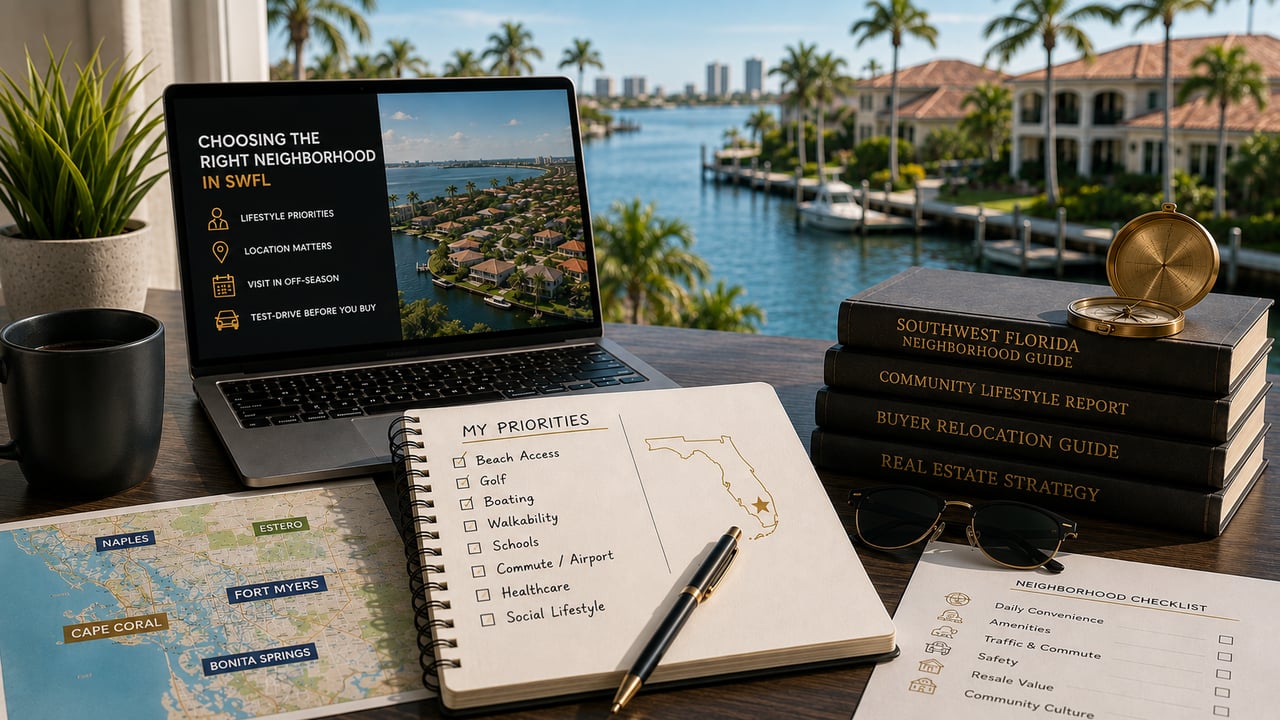
Before you look at a single neighborhood or community, make the list. Not what sounds appealing in the abstract — what you actually need to be happy in your daily life. This list looks different for different people:
- Beach proximity and access: do you want to walk to the Gulf, or is a 20-minute drive to a beautiful beach perfectly acceptable?
- Golf: are you playing 3 to 5 times per week, occasionally, or not at all? The answer determines whether a golf community is essential or irrelevant.
- Boating and water access: do you want a boat slip in your backyard, marina access nearby, or are you just happy to be near the water visually?
- Walkability: do you want to be able to walk to dinner, coffee, and shopping, or are you comfortable in a car-dependent environment?
- School quality: if you have school-age children, this may be the single most important factor — and it varies significantly across SWFL's school districts
- Commute and airport access: if you travel frequently or have family who will visit regularly, proximity to RSW Airport may be a genuine daily-life consideration
- Healthcare access: for buyers over 60, proximity to quality specialist physicians and hospital facilities is increasingly important and varies across the region
- Social culture: do you want a vibrant, active season social calendar, a quieter year-round community, or a mix of both?
Step 2: Match Priorities to Specific Geographic Areas
Once you know your priorities, the matching process becomes much more logical:
If Beach Proximity Is the Top Priority
Naples (particularly Pelican Bay and Park Shore), Marco Island, Fort Myers Beach (still rebuilding but improving), and Bonita Springs' Barefoot Beach area give you Gulf beach access that is meaningfully closer and more integrated into daily life than neighborhoods further from the coast. Inland communities — even attractive ones like Gateway or Lely Resort — require a 20 to 30 minute drive to the nearest Gulf beach.
If Golf Is Central to Your Life
North Naples has the highest concentration of private golf communities in SWFL: Quail West, Talis Park, Mediterra, Grey Oaks, and Lely Resort (bundled golf) are all within a roughly 15-mile radius. Bonita Springs adds Pelican Landing, Bonita Bay, and Palmira. Fort Myers offers Verandah and Colonial Country Club for buyers who want quality golf at more accessible price points.
If Boating and Canal Lifestyle Is the Priority
Cape Coral's canal system — over 400 miles of waterways — is the most extensive in the world and is the defining feature of the city's appeal for serious boaters. Fort Myers waterfront properties along the Caloosahatchee River, Royal Harbor in Naples for direct gulf-access, and Marco Island's canal system are all strong options depending on budget and desired proximity to open water.
If Walkability and Urban Energy Matter
Olde Naples (walkable to 5th Avenue South and the beaches) is the gold standard for walkable Naples living. Downtown Fort Myers' River District has the most genuine urban energy in SWFL and has improved dramatically in recent years. Cape Harbour in Cape Coral offers a walkable marina-village experience at more accessible price points.
If School Quality Is the Dominant Factor
Lee County Public Schools in Gateway, Three Oaks, and Estero areas consistently receive strong ratings and are popular with families. Collier County's school zones near Naples proper and East Naples also have well-regarded schools. Private school options exist throughout SWFL and are worth researching independently if public school ratings are a primary concern.
Step 3: Visit in July or August, Not January or February
This is the most important practical advice I give to every relocating buyer: if at all possible, visit SWFL in the off-season — July, August, or September — before you commit to a purchase. A January visit shows you the best version of every community. An August visit shows you the real version — what your neighbors are actually like, whether the community feels alive or deserted when season is over, what the heat and humidity actually feel like, and whether the lifestyle you are imagining holds up under real-world conditions.
Buyers who visit only in season sometimes make decisions based on an experience that they will only replicate for five months of the year. The other seven months matter just as much, and the community that feels perfect in February should also feel right to you in August.
Step 4: Spend More Than a Weekend
A weekend tour of SWFL communities produces surface-level impressions. A week gives you enough time to develop genuine feel for a neighborhood — to notice whether you are drawn to it at different times of day, whether the surrounding infrastructure (restaurants, groceries, services) matches what your daily life requires, and whether the community culture feels like a fit for who you are.
The buyers I have worked with who are happiest with their SWFL neighborhood choice are almost always the ones who took the time to stay in the area — renting a property for a week or more before buying — and used that time to genuinely test-drive the lifestyle rather than just tour homes.
Ready to make your move in Southwest Florida? Let's talk.
Whether you're buying, selling, investing, managing an estate, or just want a straight read on the market — I'm here for that conversation.
Call or text: 727.638.1704
Email: [email protected]
Or reach out at theabreugroup.com
— Daniel
Frequently Asked Questions
Q: What is the best neighborhood in SWFL for families with young children?
Gateway and Three Oaks in Fort Myers consistently attract young families with their combination of well-rated public schools, newer housing stock, community amenities, and a demographic that skews younger than much of SWFL. Estero also has strong schools and good family-oriented community options. In Collier County, certain East Naples neighborhoods and communities near the Lely area have growing family demographics.
Q: How different are the communities between Naples and Fort Myers?
More different than many buyers expect. Naples has a higher price point, a more formal luxury culture, older and wealthier demographics skewing heavily seasonal, and a stronger arts and cultural scene. Fort Myers is more diverse demographically, more affordable, has more urban energy in the River District, and has a younger year-round population. The 40-minute drive between them is short on a map but the lifestyle gap feels larger in person.
Q: Is it better to buy in a gated community or a non-gated neighborhood in SWFL?
Both have genuine appeal depending on your priorities. Gated communities offer security, maintained common areas, amenity access, and a more controlled environment. Non-gated neighborhoods in established areas like McGregor in Fort Myers or Olde Naples offer character, maturity, and walkability that planned gated communities cannot replicate. The choice is personal — I help buyers evaluate both options without bias toward either.
Q: Can I test-drive a neighborhood by renting before buying in SWFL?
Absolutely — and I strongly recommend it when the timeline allows. SWFL has a robust rental market for both short-term and annual rentals throughout the region. Renting in the specific neighborhood you are considering for 30 to 90 days before buying gives you ground-truth information that no amount of research or touring can replicate. The cost of renting for a season is small relative to the cost of buying in the wrong neighborhood.