Miami transplants moving to Naples or Fort Myers make a smaller geographic move than most relocation buyers — but the lifestyle shift is bigger than they expect. The pace, the culture, the scale, the cost, and the community character are genuinely different. Here is the honest comparison from someone who works this market every day.
Same State, Very Different World
Miami is one of the most dynamic, dense, international, and fast-paced cities in the United States. Southwest Florida is none of those things — and that is entirely the point for most people making this move. The Miami-to-SWFL migration has been significant for years and has accelerated since 2020, driven by rising costs in South Florida, quality-of-life considerations, and for many buyers, a desire for a fundamentally different pace and character of life.
What surprises Miami transplants most consistently is how different the adjustment is compared to what they expected. They knew it would be quieter. They knew it would be smaller. What they often did not fully appreciate was the depth of the cultural difference — and how quickly most of them come to genuinely prefer it.
The Cost Comparison: How SWFL Stacks Up Against Miami
Real Estate
For buyers coming from Miami's real estate market, SWFL prices feel accessible in comparison — particularly at the entry and mid-market levels. A home that would cost $800,000 to $1.2M in Miami's better neighborhoods can often be found in the $500,000 to $700,000 range in Fort Myers or Bonita Springs at equivalent or better quality. Naples closes the gap — the top end of the Naples market is competitive with Miami Beach luxury — but across most price tiers, SWFL offers meaningfully better value per square foot.
Property Taxes
Both Miami-Dade and Collier and Lee Counties are Florida counties with similar property tax frameworks, so there is no dramatic income tax differential within the state. However, Miami-Dade property tax rates run somewhat higher than Lee and Collier County effective rates, and Miami real estate values are higher, meaning the actual tax bill on a comparable lifestyle is often lower in SWFL.
Cost of Living Beyond Housing
Dining, entertainment, and services in Miami trend more expensive than in Naples and Fort Myers — though Naples's luxury restaurant scene approaches Miami pricing in the top tier. Groceries and day-to-day services are broadly comparable. The most significant financial benefit of the Miami-to-SWFL move is typically the real estate value, not a dramatic change in the broader cost of living.
The Lifestyle Differences That Matter Most
The Pace of Life
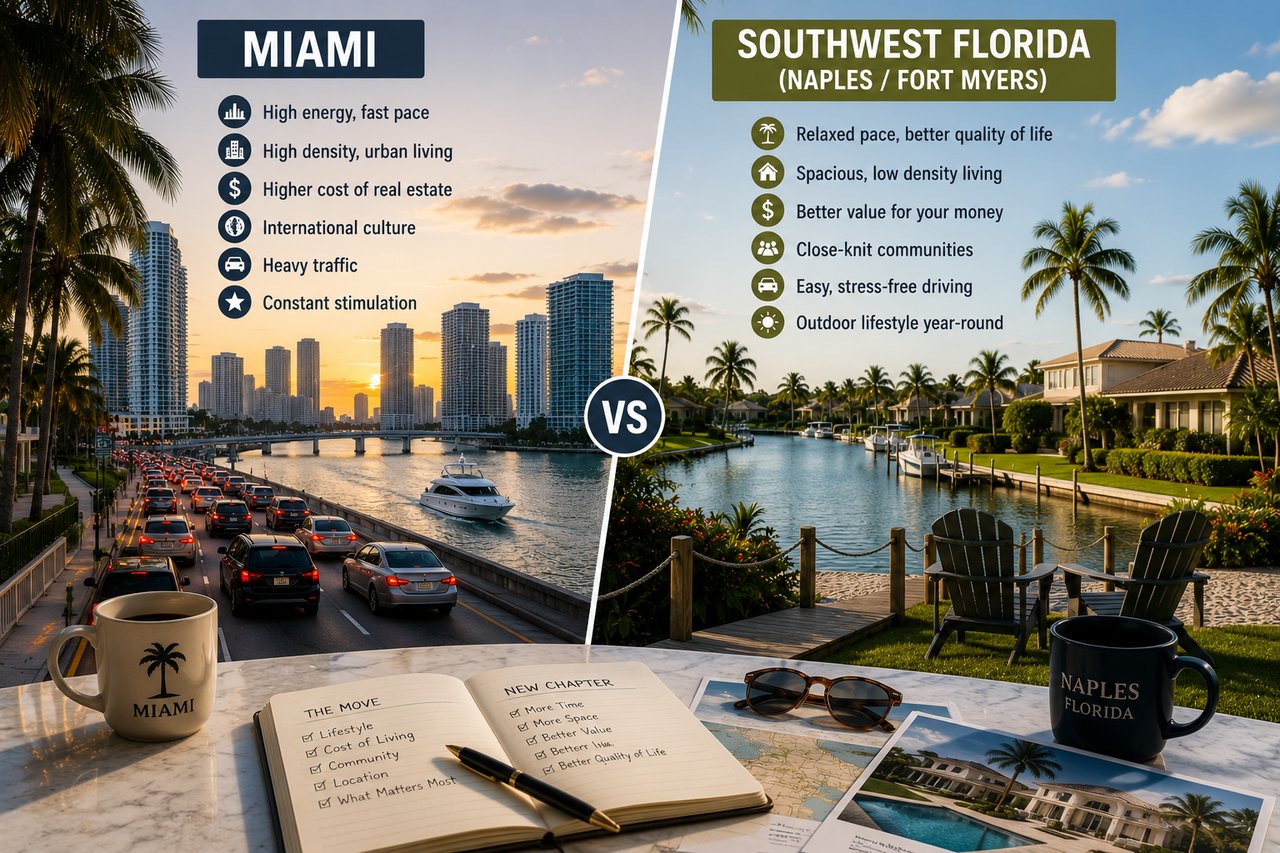
Miami moves fast. The energy is relentless — the traffic, the social scene, the professional ambition, the international culture, the constant stimulation. Southwest Florida is the opposite. The pace here is measured. People are friendly and unhurried. Customer service interactions feel like actual human exchanges rather than transactions. Life feels less like something happening to you and more like something you are actively participating in.
For Miami transplants who have been living in that high-energy environment for years, this shift is initially disorienting and quickly becomes one of the things they love most about the move. The adjustment period is real but short for most people.
The Cultural and Demographic Difference
Miami is one of the most culturally diverse cities in the Western Hemisphere — a genuinely international city with deep Latin American, Caribbean, and European influences woven into every aspect of daily life. Southwest Florida is far more homogeneous culturally, with a demographic that skews older, whiter, and more midwestern in character than Miami.
For Miami transplants — particularly those with deep roots in Miami's Latin community — this is the adjustment that takes the longest. The food, the music, the language, the social rhythms that are ambient in Miami are not ambient in Naples or Fort Myers. They exist — SWFL's demographics have diversified meaningfully in the last decade — but they are not the baseline texture of daily life the way they are in Miami.
The Outdoors as a Lifestyle, Not a Weekend Activity
Miami has the beach and Biscayne Bay. Southwest Florida has the Gulf, the Everglades, 400 miles of canals, world-class fishing, birding, kayaking, nature preserves, and a year-round outdoor lifestyle that is accessible on any given Tuesday, not just on long weekends. For Miamians who have been meaning to get out more, the move to SWFL often becomes the catalyst for genuinely different daily habits — morning beach walks, boat trips, fishing, kayaking through mangrove tunnels — that become central to their identity in a way they never were in South Florida.
The Traffic Situation
Miami traffic is genuinely among the worst in the country. The daily commute experience in Miami is a source of significant stress for most residents. Southwest Florida has traffic during season, particularly on US-41 and US-41 in Naples during peak hours, but it is not comparable to Miami. Fort Myers, Cape Coral, Bonita Springs, and Naples are navigable in ways that Miami is not, and for most residents the commute and daily driving experience is dramatically better.
Naples vs. Fort Myers: Which Makes More Sense for a Miami Transplant?
Miami transplants tend to self-select into two groups when they arrive in SWFL. Those who want the closest approximation to Miami's upscale urban energy — the restaurants, the cultural programming, the social scene — gravitate toward Naples, where the concentration of wealth, the arts infrastructure, and the international flavor of the buyer pool create an environment that feels more cosmopolitan than the rest of SWFL.
Those who are specifically moving away from high-density, high-cost urban life — who want space, a slower pace, and the outdoor lifestyle front and center — tend to land in Fort Myers or Cape Coral, where the price points are more forgiving, the communities feel more grounded, and the boat-behind-the-house lifestyle is central rather than peripheral.
Ready to make your move in Southwest Florida? Let's talk.
Whether you're buying, selling, investing, managing an estate, or just want an honest read on the market — I'm here for that conversation.
Call or text: 727.638.1704
Email: [email protected]
Or reach out at theabreugroup.com
— Daniel
Frequently Asked Questions
Q: How far is Naples from Miami?
Naples is approximately 130 miles from downtown Miami via I-75 — typically a 2 to 2.5 hour drive in moderate traffic. Fort Myers is about 150 miles from Miami, also accessible via I-75. Many SWFL residents with Miami ties make the drive regularly — it is a manageable distance for weekend visits or day trips without the commitment of a flight.
Q: Is there a large Cuban or Latin community in Southwest Florida?
SWFL's Latin community has grown significantly over the last decade, particularly in Cape Coral and Fort Myers, which have established Venezuelan, Colombian, and Cuban communities. The concentration is not comparable to Miami's, but it is a real and growing presence. The Spanish-language services, restaurants, and community organizations in Fort Myers and Cape Coral are meaningfully more developed than most people who have not been here recently expect.
Q: Will I miss Miami after moving to SWFL?
Most Miami transplants report missing specific things about Miami — the food scene, the energy, the cultural diversity, certain friends and family — while not missing the overall Miami experience: the traffic, the cost, the pace, the feeling of being overwhelmed. The distance from Miami is short enough that maintaining connections is easy. And most people find that SWFL becomes home faster than they expected.
Q: What neighborhoods in SWFL attract the most Miami transplants?
Pelican Bay and Olde Naples for buyers who want the closest analog to Miami Beach luxury. Bonita Springs communities like Pelican Landing and Palmira for those seeking upscale living at better value. Cape Coral's SW quadrant for buyers who want the water lifestyle at accessible prices. Gateway and Estero for families who prioritize schools and community over proximity to the beach.