New York is the single largest source of relocating buyers in Southwest Florida — and the lifestyle shift from New York to SWFL is significant in ways that people anticipate and in ways they absolutely do not. Here is the honest version of what this transition looks like, from someone who has watched it play out dozens of times.
New York Sends More Buyers to SWFL Than Any Other State
If you spend any time in Naples during season, you will hear the New York accent everywhere. In the line at the farmers market. At the table next to you at dinner on 5th Avenue. On the tee box at Quail West. New York City, Long Island, Westchester, and the greater New York metro area consistently rank as the single largest source of relocating buyers in Southwest Florida — a pattern that has accelerated over the last decade and shows no signs of reversing.
The financial case is compelling and well understood: New York's income tax, property tax, cost of housing, and overall cost of living create an almost absurd financial comparison when set against Southwest Florida's numbers. But the lifestyle shift is where the real story is — and it is more nuanced, more personal, and more significant than the financial spreadsheet captures.
What New Yorkers Get Right About the Move
The Financial Relief Is Real and Immediate
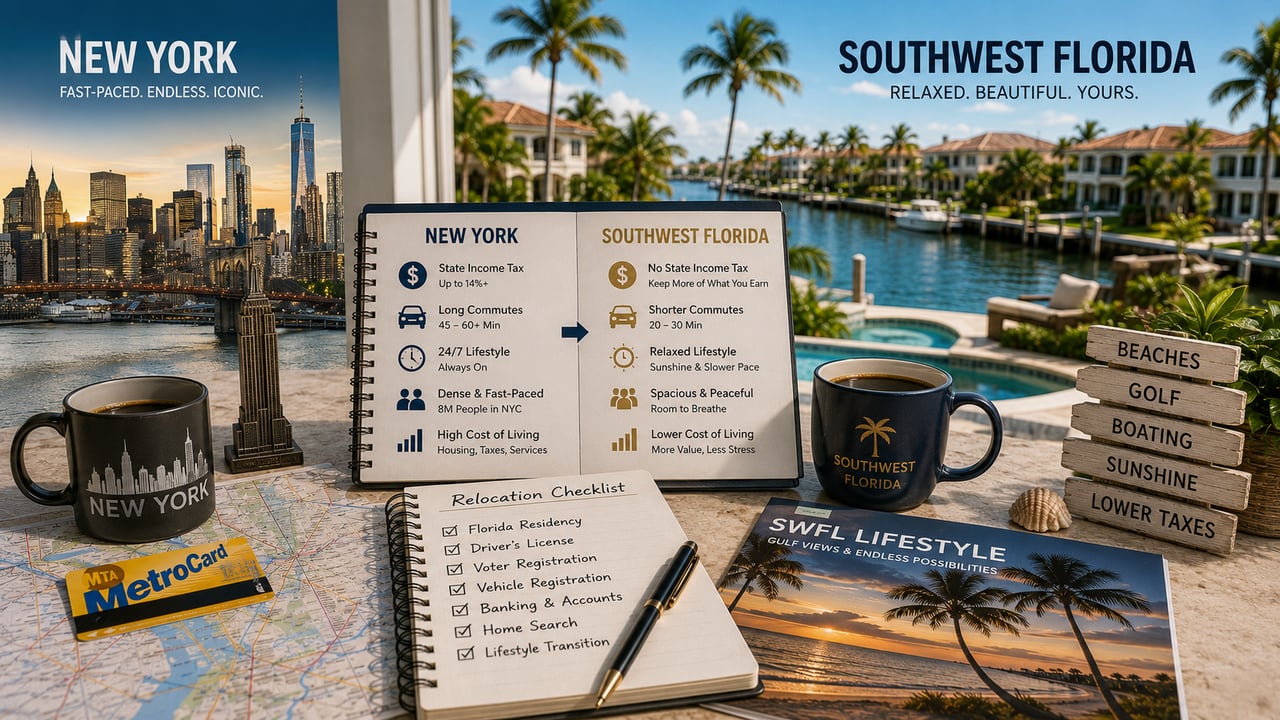
New York City residents pay federal income tax, New York State income tax (up to 10.9 percent at the top marginal rate), and New York City income tax (up to 3.876 percent) — a combined state and local rate that can exceed 14 percent at higher income levels. Moving to Florida eliminates all state and local income tax. On a $300,000 household income, that is potentially $40,000 to $45,000 per year in tax savings. The numbers become even more dramatic at higher income levels.
Add significantly lower property taxes on comparable or superior housing, lower costs for certain services, and the absence of estate and inheritance taxes at the state level, and the financial picture of the move is genuinely transformative. Most New York transplants report that the money savings alone justified the move within the first year.
The Commute Liberation
The average New York City commute is among the longest in the country — often 45 minutes to an hour each way by subway, bus, or car. Fort Myers and Naples are not commute-free cities, particularly during season on US-41, but they are in a completely different category than the New York commute experience. Most SWFL residents are within 20 to 30 minutes of wherever they need to go on any given day. The return of that time — potentially two or more hours per day — changes daily quality of life in a way that is hard to fully appreciate until you experience it.
What Surprises New Yorkers Most
The Absence of 24-Hour Everything
New York City operates on a different clock than the rest of the world. Restaurants open at 10pm. Grocery stores never close. The subway runs all night. Fort Myers and Naples — even Naples with its sophisticated dining scene — close earlier, move slower, and operate on a schedule that prioritizes morning rather than night. Most restaurants are done by 9pm. Many businesses close at 5pm or 6pm. The city goes quiet by 10pm.
For New Yorkers who are accustomed to the city's relentless availability, this adjustment takes time. Most transplants find that within six to twelve months they have shifted their own schedule forward — earlier to bed, earlier to rise — and come to genuinely appreciate the rhythm. The city going quiet at night is also part of what makes it safer and more peaceful. But the first few months of the adjustment can feel disorienting.
The Scale Difference
New York City has 8 million people in 302 square miles. Naples has approximately 22,000 residents in its city limits. Even the broader Naples metro — all of Collier County — has fewer than 400,000 people. The scale difference creates a lived experience that is radically different from New York's, and it cuts both ways: you gain quiet, accessibility, and a sense of knowing your community, and you lose the anonymity, the variety, and the constant energy of being in one of the world's great cities.
Most New York transplants make peace with this trade-off quickly. A few do not. The ones who struggle are usually the ones who needed New York's energy — the restaurants, the culture, the professional networks, the sheer stimulation — more than they realized before they left. Honest self-assessment about how much you actually need big-city energy versus how much you imagine you do is one of the most important questions to answer before committing to the move.
The Social Rebuilding Process
New Yorkers often have deep social roots — friendships of decades, professional networks, family nearby. Moving to Southwest Florida means rebuilding that social infrastructure from scratch. This process takes longer than most transplants expect — typically one to three years to develop a social circle that feels genuinely established — and the interim period can be lonely in a way that the excitement of the move obscures at first.
The communities and associations that accelerate social integration in SWFL vary by community but typically include: golf clubs, tennis and pickleball facilities, charitable organizations (Naples has an extraordinary philanthropy culture), church communities, fitness communities, and the informal networks that form among neighbors in gated community settings. New Yorkers who engage these community structures actively rebuild their social life faster than those who wait for connection to happen organically.
Fort Myers vs. Naples: Which Makes More Sense for a New York Buyer?
New York buyers tend to self-sort between Naples and Fort Myers based on a clear preference axis. Buyers who are coming specifically for the upscale lifestyle, the fine dining, the arts, and the formal luxury environment — and who have the financial resources to match Naples pricing — go to Naples. Buyers who are looking for value, more accessible price points, a slightly less formal atmosphere, and strong outdoor lifestyle opportunities without the premium tend to choose Fort Myers or the area between Fort Myers and Bonita Springs.
The interesting middle ground is Bonita Springs and Estero, which attract New York buyers who want the luxury gated community lifestyle of Naples — the golf, the beach club, the amenities — at price points that are 15 to 30 percent more accessible. Pelican Landing, The Brooks, and Palmira consistently draw this demographic.
Ready to make your move in Southwest Florida? Let's talk.
Whether you're buying, selling, investing, managing an estate, or just want a straight read on the market — I'm here for that conversation.
Call or text: 727.638.1704
Email: [email protected]
Or reach out at theabreugroup.com
— Daniel
Frequently Asked Questions
Q: How do I establish Florida residency for tax purposes when moving from New York?
Establishing Florida residency requires spending more than 183 days per year in Florida, changing your driver's license and vehicle registration to Florida, updating your voter registration, filing a Declaration of Domicile with the county clerk, and changing your primary address for banking, brokerage, and other financial accounts. New York State is aggressive about auditing residency changes, so documenting your Florida presence carefully — travel records, credit card use showing Florida spending — is important in the first few years after the move.
Q: How does Long Island compare to SWFL for families considering a move?
Long Island's strong school districts and suburban infrastructure are what keeps many families there longer than they might otherwise stay. In SWFL, the school picture is good but less uniformly excellent than Long Island's best districts. The lifestyle trade-off — SWFL's outdoor activities, lower taxes, and Gulf lifestyle versus Long Island's proximity to New York City, stronger schools, and established community infrastructure — is genuinely personal and depends heavily on the age of your children and how much proximity to the city matters to your family.
Q: Is SWFL a good fit for New Yorkers who work in finance?
Increasingly yes. The remote work infrastructure in SWFL has improved dramatically, and several financial professionals have established SWFL as their primary residence while maintaining professional relationships and travel commitments to New York. RSW Airport's direct flights to JFK and LGA make the physical commute manageable for those who need to be in New York periodically. For professionals who can do 80 percent of their work remotely and need New York access for specific client meetings or firm events, SWFL works very well.
Q: What are the most popular areas for New Yorkers specifically?
Pelican Bay and the Park Shore area in Naples attract many New York buyers who want the closest analog to the sophisticated urban amenity environment they are leaving. Bonita Bay and Pelican Landing in Bonita Springs attract Long Island and Westchester buyers particularly. Gateway and Three Oaks in Fort Myers attract New York families who prioritize space and school quality over beach proximity. And the Olde Naples area appeals to buyers who want true walkability as close to a city experience as SWFL offers.