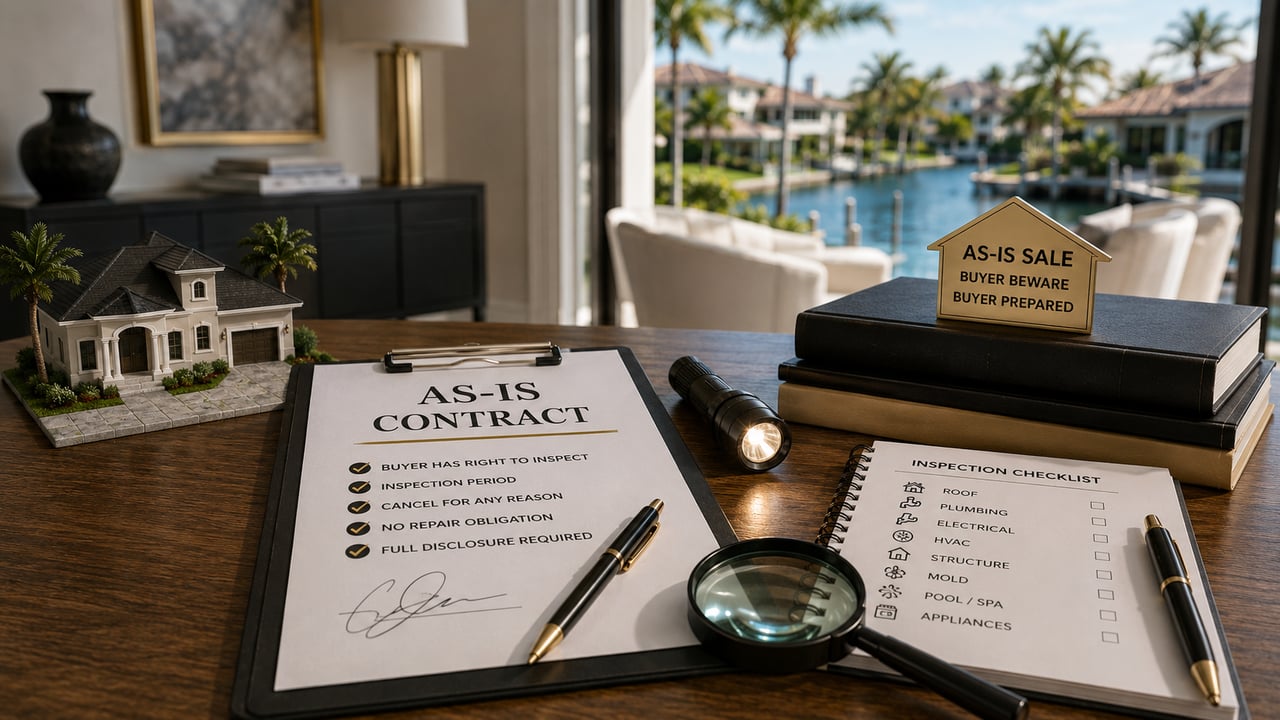
An as-is contract in Florida means the seller is not agreeing to make repairs — but it does not eliminate the buyer's right to inspect the property and cancel the contract if the inspection reveals unacceptable conditions. As-is is about who pays for repairs, not about whether the buyer can find out what needs repairing. Here is what it means for both sides of the transaction.
As-Is Is One of the Most Misunderstood Terms in Florida Real Estate
In Southwest Florida's real estate market, as-is contract addenda are extraordinarily common. Estate sales are almost always as-is. Investment property sales frequently are. Even many standard resale transactions use the as-is language because sellers want to avoid the negotiation that often follows a buyer's inspection report. And yet in my experience, very few buyers — and even some sellers — fully understand what as-is actually means in the Florida legal context.
The misconception runs in both directions. Some buyers think that as-is means they are waiving their right to inspect — they are not. Some sellers think that as-is completely insulates them from any liability related to the property's condition — it does not. Understanding the real meaning of as-is is important for everyone involved in a Florida real estate transaction.
What As-Is Means for Sellers
You Are Not Agreeing to Make Repairs — But You Still Must Disclose
When you sell a property as-is in Florida, you are telling the buyer that you are not going to make any repairs regardless of what their inspection reveals. The price reflects the property's current condition, and the buyer accepts that condition when they close. This does not mean you can hide known defects.
Florida law requires sellers to disclose all known material facts that materially affect the value of the property and that are not readily observable. This disclosure obligation exists regardless of whether the property is sold as-is or not. Selling as-is does not relieve you of the duty to disclose what you know — it simply removes the repair negotiation that would typically follow a home inspection.
Sellers who sell as-is while concealing known defects expose themselves to claims of fraud or misrepresentation that can unwind a closed transaction or result in damages claims. The as-is designation is not a shield against honest disclosure obligations.
You May Still Face Buyer Cancellations During the Inspection Period
This is the part that sometimes surprises sellers. Even with an as-is contract, the buyer typically retains the right to inspect the property during the inspection period — usually 10 to 15 days — and to cancel the contract for any reason whatsoever during that period, receiving a full refund of their earnest money. You get the offer, you accept it, and then during the inspection period the buyer can walk away for any reason — including findings they always knew were there before they made the offer.
This means an as-is offer is not the same as a certain sale. Sellers should evaluate as-is offers based on the buyer's demonstrated seriousness, the quality of their pre-approval, and whether their inspection period is reasonable — because a buyer who uses the inspection period as a free look option and then cancels is not what you were hoping for when you agreed to sell as-is.
What As-Is Means for Buyers
Your Right to Inspect Is Preserved
The most important thing for buyers to understand about as-is contracts in Florida is this: as-is does not mean as-is-without-inspection. The Florida Realtors As-Is Addendum explicitly preserves the buyer's right to inspect the property and to cancel during the inspection period for any reason. You are not waiving your right to know what you are buying — you are simply agreeing that if you close, you close without a repair commitment from the seller.
This is why a thorough home inspection is even more important on an as-is purchase than on a standard purchase. In a standard sale, you might negotiate repairs or credits after the inspection. In an as-is sale, you cannot — your only leverage is the decision to close or cancel. You need complete information to make that decision correctly.
Renegotiating After the Inspection in an As-Is Deal
Here is a practical reality that as-is sellers sometimes do not fully appreciate: buyers still renegotiate after as-is inspections, and sellers still accept those renegotiations. As-is language does not prevent a buyer from submitting a request for price reduction or repair credit — it just means the seller is not obligated to accept it. In situations where the inspection reveals significant unexpected issues, buyers will often submit a renegotiation request, and sellers who want the deal to close frequently accommodate it rather than risk losing the buyer.
The as-is language shifts the dynamic rather than eliminating the negotiation entirely. Sellers who understand this can approach as-is transactions more strategically — pricing the property to reflect its condition upfront rather than pricing at full value and then being surprised when the buyer pushes back after the inspection.
The As-Is Addendum in Practice: What to Look For
When reviewing an as-is offer or an as-is listing, the key elements to understand in the addendum include:
- Inspection period length: the standard Florida as-is addendum specifies the inspection period during which the buyer may cancel for any reason. Sellers generally prefer shorter periods; buyers prefer longer. Ten to fifteen days is typical in SWFL.
- What 'any reason' actually means: the buyer's right to cancel during the inspection period is genuinely broad — they can cite any reason or no reason at all. This is strong buyer protection and it is intentional.
- Walk-through rights before closing: the as-is addendum typically preserves the buyer's right to a final walk-through before closing to confirm the property is in substantially the same condition as when the contract was signed.
- Survival of disclosure obligations: the seller's disclosure obligations survive the as-is language — any known material defect must still be disclosed regardless of the as-is designation.
Ready to make your move in Southwest Florida? Let's talk.
Whether you're buying, selling, investing, managing an estate, or just want a straight read on the market — I'm here for that conversation.
Call or text: 727.638.1704
Email: [email protected]
Or reach out at theabreugroup.com
— Daniel
Frequently Asked Questions
Q: Should buyers always get a home inspection on an as-is property?
Absolutely yes — in fact, the inspection is more important on an as-is property than on a standard sale because it is your only opportunity to discover problems before you are committed to buying the property in its current condition. Skipping the inspection on an as-is purchase means potentially buying a home with major hidden defects and no recourse after closing.
Q: Can a seller refuse to disclose defects because the property is sold as-is?
No. Florida law requires sellers to disclose known material defects regardless of the as-is designation. A seller who knowingly fails to disclose a material defect — active roof leak, prior flooding, structural problems, known mold — can be held liable for fraud or misrepresentation even if the property was sold as-is. The as-is language only affects repair obligations; it does not eliminate the disclosure requirement.
Q: What happens if I discover a major defect after closing on an as-is purchase?
If the defect was a known material fact that the seller failed to disclose, you may have a legal claim for fraud or misrepresentation notwithstanding the as-is designation. If the defect was genuinely unknown to the seller and not reasonably discoverable during your inspection period, the as-is language generally protects the seller. This is why thorough home inspections and careful pre-closing due diligence are so critical on as-is purchases.
Q: Do as-is sales close faster than standard sales in SWFL?
Not necessarily — the inspection period is typically the same length regardless of whether the contract is as-is. However, as-is transactions can close faster after the inspection period because there is no repair negotiation phase. If the buyer completes their inspection and decides to proceed without requesting any repairs or price adjustments, the transaction can move directly to closing on the original timeline.