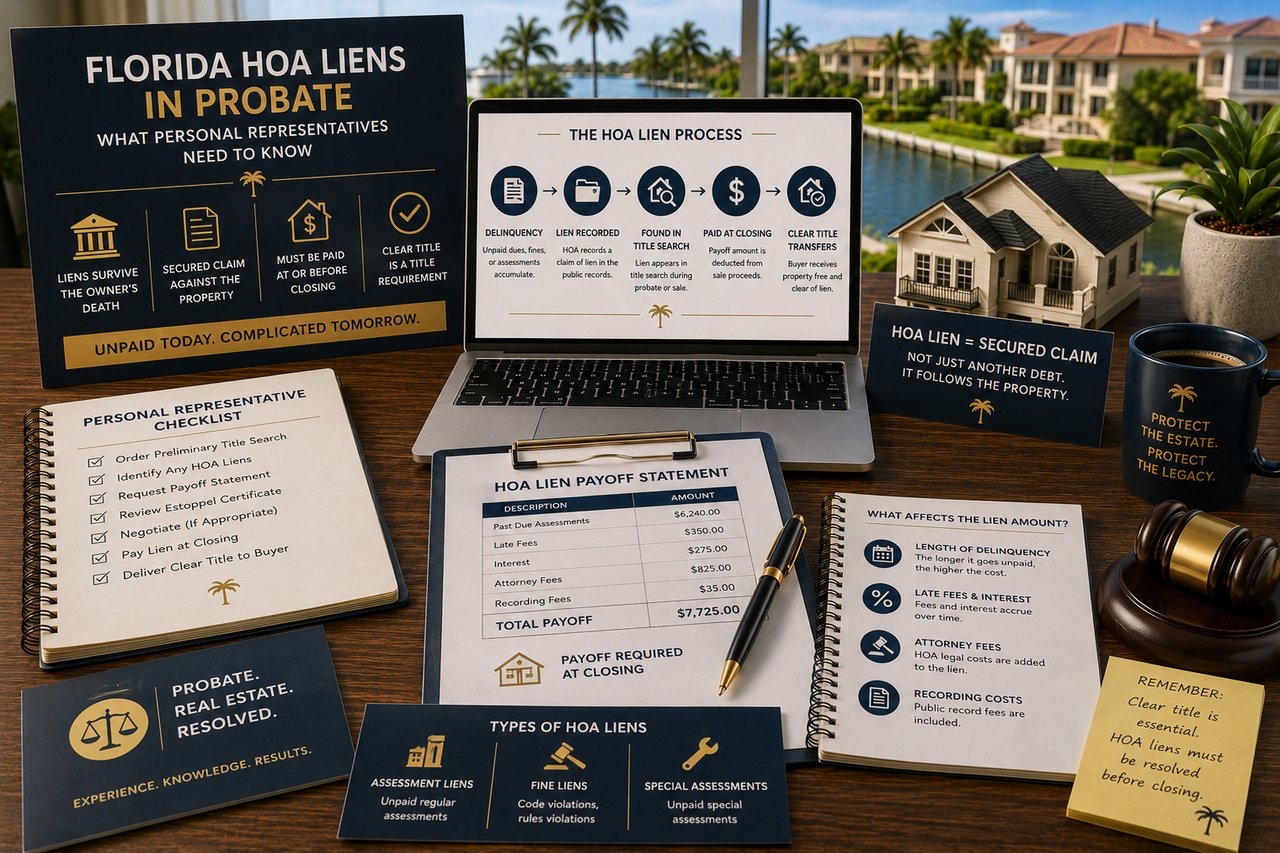
HOA liens recorded against a Florida property survive the owner's death and must be resolved before clear title can transfer to a buyer. In probate, HOA liens are treated as secured claims against the property — not just unsecured estate debts — and their resolution is a title company requirement at closing. Here is how they work and what personal representatives need to know.
HOA Liens Are More Common in Probate Than You'd Expect
When families in Southwest Florida discover that an inherited property has an HOA lien against it, the reaction is usually some combination of surprise and frustration. How could someone let the HOA fees go unpaid long enough to generate a lien? The reality is that it happens more often than people expect — particularly in cases where the decedent was elderly, in declining health, experiencing cognitive decline, or simply lost track of recurring obligations in their final years.
Understanding what an HOA lien is, how it affects the estate administration, and what the resolution process looks like is important for any personal representative dealing with inherited property in SWFL's heavily HOA-governed market.
Florida HOA Liens: The Legal Framework
How HOA Liens Are Created
Under Florida Statute 720.3085, a homeowners association has the statutory right to place a lien on a property when the owner is delinquent on assessments, fines, or other charges owed to the association. The lien is perfected by recording a claim of lien in the public records of the county where the property is located. Once recorded, the lien is a matter of public record and will be discovered in any title search.
The lien can be foreclosed by the HOA if the delinquency is not resolved — though the HOA foreclosure process in Florida has specific requirements and timelines. More commonly in estate situations, the lien is identified in the title search and resolved at or before closing rather than through foreclosure.
HOA Liens vs. Mortgage: Priority Rules
Florida's HOA lien statute gives HOAs a super-priority lien for the most recent 12 months of unpaid assessments — meaning those 12 months of assessments take priority over the first mortgage in a foreclosure situation. Beyond those 12 months, the mortgage takes priority over the HOA lien. In a standard sale (rather than a foreclosure), all liens — mortgage, HOA, and others — are paid off from the sale proceeds in the order specified by the contract and the title company's closing instructions.
What Happens in Probate
The HOA Lien Is a Secured Claim, Not an Unsecured Creditor Claim
This is an important distinction for personal representatives to understand. When a creditor files a claim during the Notice to Creditors period in Florida probate, they are asserting an unsecured claim against the estate's general assets. An HOA lien is different — it is a secured claim attached to the specific property, much like a mortgage. The HOA lien does not need to be filed as a probate claim during the 90-day creditor period to remain enforceable. It follows the property regardless of the probate process.
This means that even if the Notice to Creditors period runs without the HOA filing a claim, the recorded lien remains and must be satisfied before clear title can transfer. The title company will not close without it being resolved.
The Personal Representative's Responsibilities
As personal representative, your responsibilities regarding an HOA lien on the estate property are:
- Identify it: the preliminary title search you should run early in the administration will reveal any recorded HOA liens
- Obtain a payoff statement: contact the HOA or its management company for a current payoff statement showing the total amount owed including principal, interest, late fees, and attorney fees if the HOA has incurred them in connection with the lien
- Negotiate if appropriate: as discussed in the code enforcement lien context, HOA fine components are sometimes negotiable — particularly when a new personal representative engages the HOA cooperatively and brings the property into compliance
- Pay at closing: if the lien is not paid before closing, the title company will withhold the payoff amount from the seller's proceeds at closing and remit it directly to the HOA
The Estoppel Letter Connection
As covered in the HOA estoppel letter post, the estoppel certificate issued by the HOA at the time of a sale will reflect any outstanding balances and confirm the payoff amount for closing. In an estate sale situation, the estoppel letter is particularly important because it certifies the total amount required to clear all outstanding obligations to the HOA — dues, special assessments, fines, and lien-related charges — which must be collected from the sale proceeds before the estate receives its net share.
Special Assessment Liens: A Related Issue
In Florida condominiums specifically, special assessments can generate liens similar to HOA liens when they are not paid. Given the current SWFL environment where many condo buildings are dealing with significant structural inspection requirements and deferred maintenance assessments, personal representatives of estates with condo properties need to be particularly attentive to any pending or unpaid special assessments that may have resulted in recorded liens.
The condo association estoppel certificate — governed by Florida Statute 718.116 rather than the HOA statute — will reveal these issues. Getting this certificate early in the administration, rather than waiting until you are under contract, gives you the full picture before it affects the closing timeline.
Ready to make your move in Southwest Florida? Let's talk.
Whether you're buying, selling, investing, managing an estate, or navigating any real estate situation — I'm here for that conversation.
Call or text: 727.638.1704
Email: [email protected]
Or reach out at theabreugroup.com
— Daniel
Frequently Asked Questions
Q: Can an HOA foreclose on a property in a Florida estate during probate?
Yes — an HOA can pursue foreclosure on a delinquent property even if the owner has died and the property is in probate. Florida's HOA foreclosure process applies regardless of the owner's status. However, personal representatives who engage promptly with the HOA and establish a payment plan or commit to resolving the lien at closing typically prevent foreclosure from being initiated or continued. The HOA's goal is to collect what it is owed, not to acquire the property.
Q: Who pays the HOA lien — the estate or the buyer?
The estate pays the HOA lien. In a sale transaction, the payoff amount is deducted from the seller's net proceeds at closing. The buyer receives the property free and clear of the lien after closing. If the estate lacks sufficient other assets to cover the lien and the sale proceeds are needed to pay both the lien and other estate expenses, the title company coordinates the proper disbursement sequence.
Q: What if the HOA lien amount exceeds the property's equity?
If the total of the mortgage payoff, HOA lien, and other closing costs exceeds the sale price — meaning the property has negative equity — the situation is complex and requires careful coordination between the probate attorney, the lender, and the HOA. Short sale options, deed in lieu arrangements, or negotiated payoff reductions may be available. This is a situation where experienced professional guidance is essential.
Q: How long does it take to resolve an HOA lien in a Florida estate sale?
Obtaining the payoff statement and confirming the lien amount typically takes one to two weeks if the HOA is responsive. If the lien has been referred to an HOA attorney, the payoff may include attorney fees that need to be confirmed directly with that attorney. The actual resolution happens at closing — no separate legal proceeding is required in a straightforward sale scenario.
This post is intended for general educational and informational purposes only and does not constitute legal advice. The information provided here reflects general principles of Florida probate law and should not be relied upon as a substitute for advice from a licensed Florida attorney. Every estate is different, and the specific facts of your situation may lead to different legal outcomes. If you are dealing with probate, estate administration, or any related legal matter, please consult with a qualified Florida probate attorney before taking action.