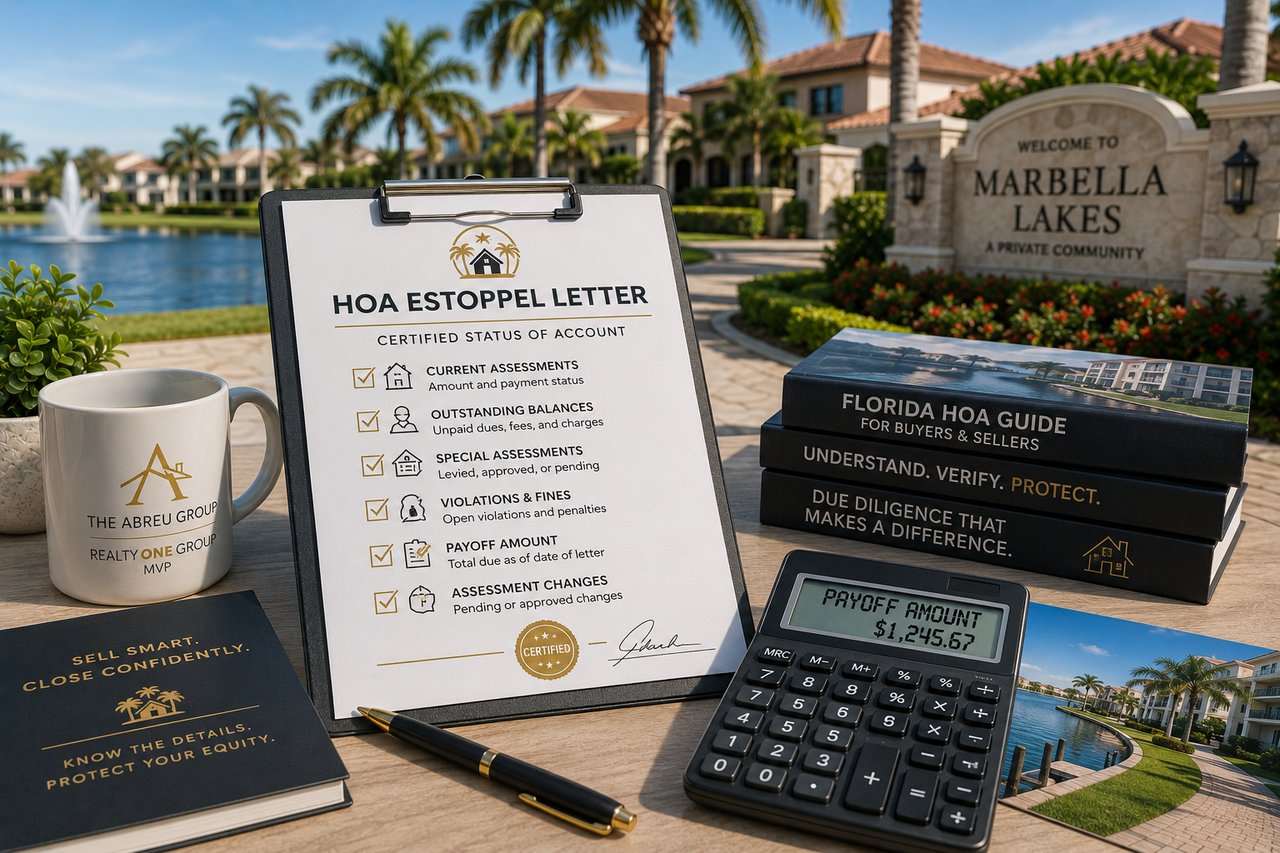
An HOA estoppel letter is a document issued by a Florida homeowners association that certifies the exact status of all dues, fees, assessments, and violations associated with a specific property at a specific point in time. It is a required part of most Florida real estate closings in HOA communities, and what it reveals can directly affect the transaction. Here is everything buyers and sellers need to know.
One Document That Can Change the Numbers at Closing
Most buyers and sellers in Florida HOA communities have heard the term 'estoppel letter' somewhere in the transaction process. Far fewer understand what it actually is, why it is required, or what happens when it reveals something unexpected. Given that approximately 70 percent of homes sold in SWFL are in HOA communities, this is a document that nearly every buyer and seller will encounter — and understanding it is genuinely important.
What an HOA Estoppel Letter Certifies
Under Florida Statute 720.30851, every homeowners association in Florida is required to provide an estoppel certificate upon written request from a parcel owner, mortgagee, or buyer. The estoppel letter is a certified statement from the HOA that documents:
- The current monthly or quarterly HOA assessment amount and the date through which it has been paid
- Any outstanding unpaid assessments, dues, or fees owed by the current owner
- Any special assessments that have been levied or approved — whether currently due or payable in the future
- Any open code violations or outstanding fines against the property
- The total amount required to be paid to the HOA as a condition of closing (the payoff amount)
- Any pending or approved changes to the assessment amount
Once issued, the estoppel letter is binding on the HOA for a specific period — typically 30 days for electronic delivery or 35 days for physical delivery. Within that window, the HOA is legally bound by the numbers it certified, even if the actual outstanding amounts are different.
Why Buyers Need to See It Before Closing
Unpaid Dues Transfer as a Lien
In Florida, unpaid HOA assessments are secured by a lien on the property. Unlike some other states, Florida HOA liens can survive a sale — they follow the property, not the owner. If a seller has outstanding unpaid HOA dues and those dues are not satisfied at closing, the buyer can inherit that liability.
The estoppel letter prevents this by requiring the seller to pay all outstanding dues and fees from the sale proceeds at closing before the buyer takes title. The title company uses the estoppel letter to calculate exactly what the seller must pay and withholds those funds before disbursing the net proceeds.
Special Assessments: The Line Item That Surprises Buyers Most
Special assessments are one-time charges levied by the HOA for major capital expenditures — roof replacements on condo buildings, pool resurfacing, major infrastructure repairs, or reserves replenishment. In Florida's post-2022 environment, where condo buildings are facing significant inspection and reserves requirements, special assessments have become increasingly common and increasingly large.
The estoppel letter will reveal any special assessments that have been levied against the property — whether already due, payable in installments, or assessed but not yet called. For buyers in condo communities especially, a large pending special assessment can change the financial picture of a purchase significantly. This is information you want before you close, not after.
Why Sellers Need to Request It Early
The Florida Timeline Requirements
Florida law gives HOAs specific timeframes to respond to estoppel requests. An HOA must provide the estoppel certificate within 10 business days of receiving a written request if it is requested by the parcel owner. The HOA may charge a fee for preparing the estoppel — Florida law caps this at $250 for current owners and $500 for delinquent properties, with an additional $100 expedite fee if the requestor wants delivery within three business days.
Sellers who wait until they are already under contract to request the estoppel can create timeline pressure. Requesting the estoppel as soon as you list — or even before — gives you a clear picture of your payoff obligations and eliminates surprises when the closing disclosure is prepared.
What If the Estoppel Reveals Problems?
If the estoppel letter reveals outstanding dues, violations, or special assessments that the seller did not disclose, it can trigger a renegotiation of the purchase price or, in cases where the amounts are significant, a buyer's decision to cancel during the inspection period. Sellers who are aware of outstanding HOA issues should disclose them proactively — the estoppel letter will surface them anyway, and a proactive disclosure builds trust while a discovered issue damages it.
Condo Associations: The Estoppel Certificate Process Is Similar but More Complex
For condominiums, the equivalent document is governed by Florida Statute 718.116 rather than 720.30851, and the condominium association estoppel must also certify the status of any pending or approved special assessments, the current monthly maintenance fee, and any outstanding balances. In the current environment where many condo buildings are dealing with structural inspection requirements and deferred maintenance assessments, the condo estoppel is one of the most important due diligence documents in a condominium transaction.
Ready to make your move in Southwest Florida? Let's talk.
Whether you're buying, selling, investing, managing an estate, or just want a straight read on the market — I'm here for that conversation.
Call or text: 727.638.1704
Email: [email protected]
Or reach out at theabreugroup.com
— Daniel
Frequently Asked Questions
Q: Who pays for the HOA estoppel letter in Florida?
Typically the seller pays the estoppel fee, as they are the current owner of record and the estoppel is documenting their account status. However, this is a negotiable item in the purchase contract. The fee is capped by Florida law at $250 for a standard estoppel from a current-owner account and $500 for a delinquent account, plus a $100 expedite fee if needed.
Q: Can a buyer use the estoppel letter to get out of a contract?
Not directly — the estoppel letter itself is not a contingency in the standard Florida purchase contract. However, if the estoppel reveals a significant special assessment or outstanding balance that was not disclosed by the seller, the buyer may be able to use the general inspection period cancellation right or a fraud/misrepresentation argument depending on the circumstances. This is a situation where having a buyer's agent who understands the contractual implications is valuable.
Q: How long is a Florida HOA estoppel letter valid?
The estoppel certificate is binding on the HOA for 30 days from the date of delivery (electronic) or 35 days (physical). If the closing is delayed beyond that window, a new estoppel will need to be requested, which may reveal changes in the amounts owed and may require an additional fee.
Q: What is the difference between an estoppel letter and HOA financials?
They are different documents that answer different questions. The estoppel letter certifies the specific financial obligations and violations for one specific property and one specific owner. The HOA financials — the budget, reserve study, and financial statements — give a picture of the overall financial health of the association. Both are important in a condominium purchase; the estoppel tells you what you owe, the financials tell you what you are buying into.