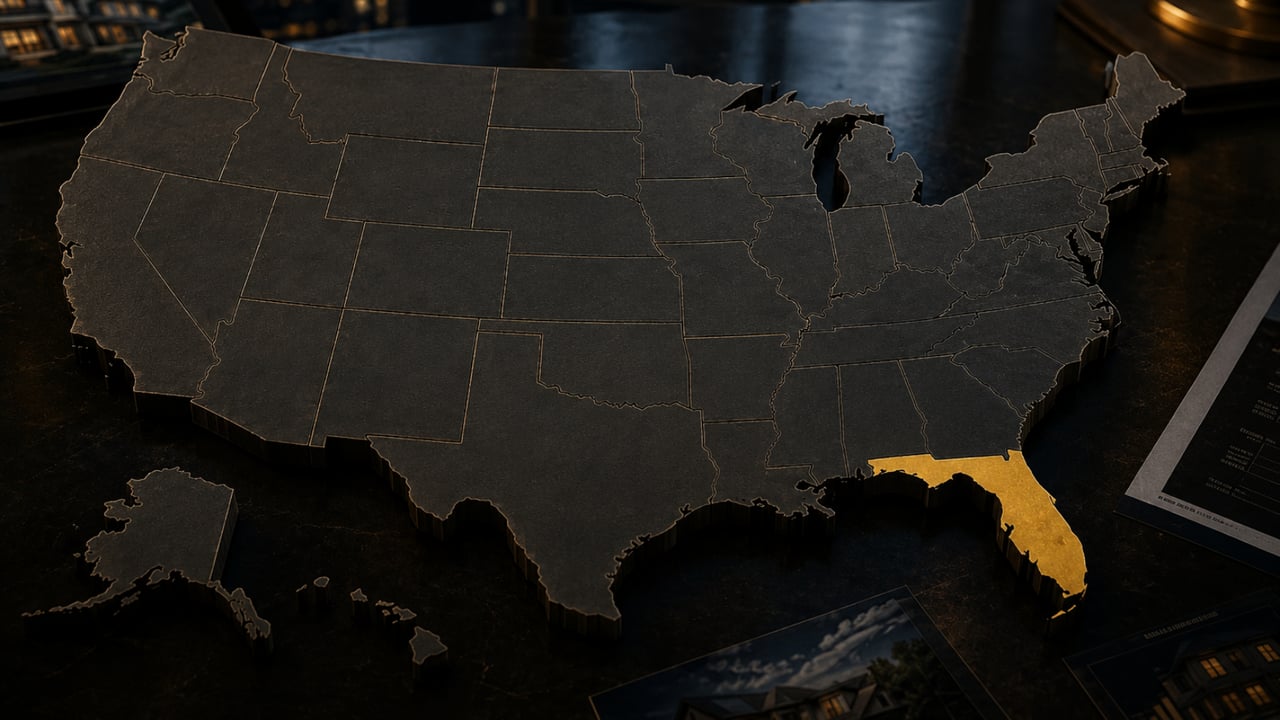
Florida Gets a 'B' in the 2026 Housing Report Card — Here's What SWFL Buyers and Sellers Need to Know
Every year, buyers, sellers, and real estate watchers across the country try to answer a deceptively simple question: Is this a good state to buy a home right now?
Realtor.com's research team just gave that question a rigorous answer. Their 2026 Grading the States report assigned every state a letter grade based on two equally weighted factors: how affordable homes are for local earners, and how aggressively each state is building to meet demand. The results reveal a clear regional divide — and Florida landed squarely in the middle of the honor roll.
Here's the breakdown, and more importantly, what it means if you're making a real estate move in Naples, Fort Myers, Cape Coral, Bonita Springs, or Estero.
How the Grades Work
Realtor.com scored all 50 states and Washington, D.C. on a 100-point scale. Half the score comes from affordability — specifically, what share of homes for sale are accessible to households at different income levels, and what percentage of the median income is required to purchase the median-priced home. The other half measures homebuilding output, using each state's share of national building permits relative to its population share, and how new construction prices compare to existing home prices.
The grading scale runs from A+ (77.5 and above) down to F (below 30). No state earned an A+ this year — a reminder that even the best-performing states have real work left to do.
Where Florida Stands: A 'B' and 11th in the Nation
Florida earned a 63.7 out of 100, good for a B grade and the #11 overall ranking in the country. That places it ahead of every other large Sun Belt state except Texas (#4) and North Carolina (#5), and well ahead of every Western and Northeastern state.
Here's how the top of the class shook out:
Florida's grade reflects a genuinely strong homebuilding story, paired with affordability challenges that are real — but manageable in the right market context.
Florida's Homebuilding Strength: A Rare Bright Spot
Where Florida truly stands out is on the construction side of the equation. The state accounts for 12.3% of all building permits issued nationally — second only to Texas. Its permit-to-population ratio of 1.79 ranks 5th in the country, meaning Florida is building substantially more homes per capita than the national average.
Even more notable: Florida is one of only five states in the entire country where new construction homes are actually cheaper than existing ones. The state's new-construction premium is -3.1%, meaning a newly built home costs about 3% less than a comparable existing home. That's a rare and meaningful distinction that signals builders are competing on price — which is good for buyers who want something move-in ready without paying a premium for it.
The other four states with negative new-construction premiums are South Carolina, Idaho, California, and North Carolina. The fact that Florida is in that group — given its population size and demand levels — reflects a market where builders are genuinely trying to expand access, not just build luxury product.
What this means for SWFL: Communities across Southwest Florida continue to benefit from this building momentum. New construction in areas like Estero, Bonita Springs, Gateway, and Cape Coral's outer corridors represents some of the best value in the region — move-in ready homes at prices that often compete favorably with older existing inventory. If you've been sitting on the sidelines waiting for prices to come down, builder incentives right now are doing some of that work for you.
The Affordability Reality: Strong Relative to Most, Still a Stretch for Many
Florida's affordability scores are the more complicated side of the ledger. The statewide median listing price of $432,742 requires about 40.6% of the median Florida household income of $72,722 to cover annual housing costs — above the commonly cited 30% threshold that defines affordability for most financial planners.
That said, context matters. Florida's 0.59 REALTORS® Affordability Score reflects the statewide picture, but Southwest Florida's market is layered. The Naples and Fort Myers metro areas serve a broad spectrum of buyers — from workforce buyers in Cape Coral and Lehigh Acres, where entry-level pricing remains among the most accessible in the region, to luxury buyers in Pelican Bay, Mediterra, Quail West, and Talis Park, where the concept of 'affordability' is simply a different conversation.
The national data reminds us that Florida, as a whole, is building toward affordability even when current prices don't fully reflect that progress yet.
The Regional Divide: Why SWFL's Position Is a Competitive Advantage
One of the most striking findings in this report is just how stark the regional divide has become. Every A and B grade in the 2026 report belongs to a state in the South or Midwest. The average score for Southern states is 60.4. Western states average 41.8. The Northeast averages just 30.0.
That's not a minor gap — that's a structural reality reshaping where Americans can afford to own homes.
Six states received an F grade: Connecticut, California, Hawaii, Rhode Island, Massachusetts, and New York. New York landed dead last with a score of just 8.5 — its median home requires 55.2% of median income, and it issues less than half the building permits its population share would suggest.
What that means for Southwest Florida is simple: we sit in one of the best-positioned regions in the country for long-term housing market health. The same buyers fleeing the Northeast and California who drove the 2021-2022 wave haven't disappeared — they've just become more deliberate. When a buyer from New York or Massachusetts looks at Florida, they're not just comparing home prices. They're comparing what $432,000 looks like here versus what $668,000 buys them in their home state — which, in New York, might be a two-bedroom apartment.
SWFL competitive edge: Naples, Fort Myers, and Cape Coral continue to attract high-income relocators from states with F-grade housing markets. That sustained demand — particularly at the mid-luxury and luxury price points in communities like Lely Resort, Vineyards, Bonita Bay, and Cape Harbour — underpins our local market's resilience even when national headlines suggest softening.
What Buyers in SWFL Should Take From This
If you're actively shopping for a home in Collier or Lee County right now, here's how to use this national data to your advantage:
New construction deserves a serious look. With Florida being one of five states where newly built homes are priced below existing inventory, comparing builder incentive packages against resale listings is more important than ever. In Cape Coral, Bonita Springs, and Estero, this gap can be significant.
Don't wait for a national affordability breakthrough. Only 11 of 51 states and DC have a median home that's affordable to their median earner. Florida isn't one of them — but neither are most states. Waiting for a national affordability correction that improves the whole market equally is unlikely to be a winning strategy.
Interest rates remain the bigger lever. The Realtor.com report measures affordability against income — but the monthly payment calculation also depends heavily on the rate you lock. Even modest rate movement can shift a home from a stretch to comfortable. Having a mortgage professional in your corner before you shop puts you in a much stronger position.
Understand your specific submarket. Statewide data doesn't tell the Naples story, the Cape Coral story, or the Bonita Springs story. Local RPR data shows us exactly where inventory stands, where prices are moving, and where the opportunities are in 2026.
What Sellers in SWFL Should Take From This
For homeowners thinking about selling, this national picture is actually a tailwind:
Florida's reputation as a destination state is validated by the data. A B grade — with exceptional building credentials — signals a healthy, functional market to buyers who do their homework. That's the profile of the buyer who moves deliberately and pays fair value.
Relocators from high-cost states are still your strongest buyer pool. A buyer from Connecticut (F grade), California (F grade), or New York (F, last place) walks into the SWFL market and finds relative affordability even at our price points. That perspective drives motivated, qualified offers.
New construction is your competition — price accordingly. With builders delivering competitively priced inventory, sellers of existing homes need to be honest about condition, updates, and value. A buyer comparing your 2004-built home in Lely Resort against a new build in a similar community is making a rational calculation. Make sure your pricing reflects that reality.
The Bigger Picture: A Nation Still Short 4 Million Homes
The Realtor.com report opens with a sobering statistic: the nationwide housing shortage continues to hover near 4 million homes. That's not a SWFL-specific problem — it's a structural national issue that's been building for years and won't resolve quickly.
States that earn A and B grades, like Florida, are doing more of the right things than most — but even the top performers haven't fully closed the gap. The report concludes that meaningful improvement at the bottom requires permissive zoning reform, streamlined permitting, and incentives for entry-level construction. That's a policy conversation happening at every level of government right now, and its outcomes will shape the housing market for the next decade.
For buyers and sellers in Southwest Florida, the practical takeaway is this: we're in a market that's working harder than most to balance supply and demand. That doesn't mean every price is right or every deal is a steal. It means working with someone who reads this data and knows how it translates locally.
Ready to Make Your Move in SWFL?
The national housing data tells one story. Your specific situation in Naples, Fort Myers, Cape Coral, Bonita Springs, or Estero tells another. Whether you're buying, selling, or just trying to figure out if now is the right time, let's talk through the numbers that actually apply to your market.
Daniel Abreu brings a background in legal analysis and contract strategy to every transaction — so when you're navigating one of the biggest financial decisions of your life, you have someone in your corner who reads the fine print.
Call or text: 727.638.1704
Email: [email protected]
Visit: theabreugroup.com
Frequently Asked Questions
What grade did Florida receive in the 2026 housing report card?
Florida earned a B grade with a score of 63.7 out of 100, ranking 11th nationally in Realtor.com's 2026 Grading the States report on affordability and homebuilding.
Is Florida considered an affordable state?
At the state level, Florida's median home price of $432,742 requires roughly 40% of the median household income — above the 30% affordability threshold. However, Florida ranks better than most large states due to its exceptional building output and, uniquely, new homes that are actually priced below existing inventory statewide.
Which states had the worst housing grades in 2026?
Six states earned F grades: New York (ranked last with 8.5/100), Massachusetts, Hawaii, Rhode Island, California, and Connecticut. These states share high prices, limited new construction relative to population, and structural barriers to affordability reform.
Why is Florida building so many homes right now?
Florida accounts for 12.3% of all building permits issued nationally — second only to Texas — despite representing a smaller share of the U.S. population. A combination of population demand, available land in certain corridors, favorable regulatory environments in many municipalities, and strong builder interest in the Sun Belt market drives this activity.
Does this national data apply to the Naples or Fort Myers market specifically?
National and state-level data provide helpful context, but local market dynamics in Collier County (Naples, Marco Island) and Lee County (Fort Myers, Cape Coral, Bonita Springs, Estero) can differ significantly from statewide averages. Working with a local professional who combines national research with granular RPR data gives you the most accurate picture of what's happening in your specific neighborhood or price range.
Should I buy a new construction home in SWFL instead of an existing home?
It depends on your priorities, timeline, and budget. Florida's negative new-construction premium (-3.1% statewide) means new builds are competitive on price — and often come with builder incentives, warranties, and modern features. However, location, lot size, community amenities, and HOA structure all factor in. The right answer varies by buyer situation, which is why we always recommend comparing both categories before deciding.