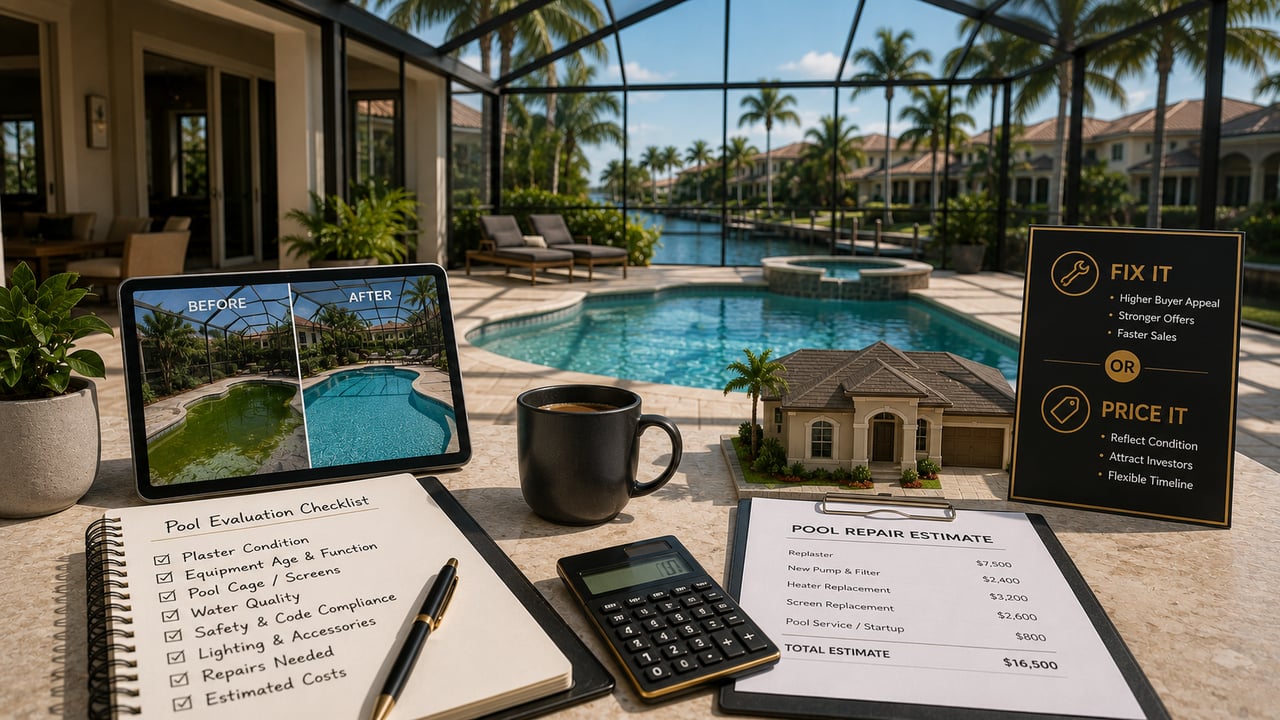
A pool that needs resurfacing, equipment replacement, or cage repairs is a real buyer concern in Southwest Florida — but it does not have to derail your sale. The decision between fixing it before listing and pricing to reflect its condition depends on the scope of work, your timeline, and the competitive landscape. Here is how to think through it.
Most Buyers in SWFL Want a Pool — But They Want a Working One
In Southwest Florida, a private pool is one of the most sought-after features in residential real estate. Buyers in every price range from $350,000 to $5M consistently cite a pool as either essential or strongly preferred. The challenge for sellers is that a pool in poor condition — green water, damaged cage, worn plaster, aging equipment — can actually hurt more than it helps. Buyers see a problem, not a feature, and they use that problem as negotiating leverage.
I have worked with sellers whose pool situation became the central issue in their sale — either because they did not address it before listing and lost buyers who did not want to deal with it, or because they addressed it intelligently and turned a liability into a genuine selling point. Here is what I have learned from those situations.
The Four Most Common Pool Problems at Listing Time
Worn or Stained Plaster Surface
Pool plaster typically lasts 10 to 15 years in Florida's climate before it shows significant wear — staining, roughness, and in some cases structural deterioration. A visibly worn plaster surface is immediately noticeable and is one of the first things buyers comment on during showings. The cost to replaster a standard SWFL pool runs $5,000 to $10,000 depending on the pool size and the type of finish selected. A fresh plaster surface — particularly a white or light-colored finish — transforms the visual appearance of the entire backyard instantly.
Aging or Non-Functional Equipment
Pool equipment — pump, filter, heater, and in salt pools the salt cell — has a finite lifespan. A pump that is 10 years old in Florida is at or near end of life. A heater that does not function properly is a meaningful quality-of-life issue during cooler months. Buyers who notice aging or non-functional equipment calculate the replacement cost and use it in their offer. A new variable-speed pump and filter system runs $1,500 to $3,000 installed, and a pool heater replacement runs $2,500 to $5,000.
Damaged or Deteriorating Pool Cage
The pool cage — the aluminum and screen enclosure that covers most SWFL pools — takes regular wear from UV exposure, wind events, and general aging. Torn or missing screens, bent or compromised framing, and sagging sections are all immediately visible during showings and immediately raise the question of whether there was storm damage and whether an insurance claim was filed. Screen replacement for a standard cage runs $1,500 to $4,000. Full cage replacement for a significantly compromised structure can run $15,000 to $40,000 depending on the size and materials.
Green or Poorly Maintained Water
This one is the most immediately off-putting to buyers and the most easily preventable. A pool that is actively green — whether from algae, imbalanced chemistry, or a non-functional pump — creates a strong negative first impression that affects how buyers perceive the entire property. The solution is straightforward: have the pool professionally shocked, balanced, and maintained on a weekly service schedule before the listing goes live. The cost is minimal relative to the impression impact.
Fix It or Discount It? The Math
When Fixing Makes Sense
The repair-before-listing approach makes sense when the cost of the repair is meaningfully less than the likely buyer discount, and when the repair can be completed in a timeframe that does not significantly delay your listing. The clearest case for fixing:
- Replastering: a $7,000 investment in fresh plaster typically generates a $10,000 to $15,000 improvement in buyer perception and offer price — strong positive ROI
- Screen replacement on a damaged cage: a $2,500 investment in new screening eliminates a liability that buyers will negotiate down by $5,000 or more
- Green water and maintenance: a $500 to $1,500 pool service investment is virtually always worth making — no buyer is going to overlook actively green water and price fairly
When Discounting Makes More Sense
The discount approach makes sense when the scope of repair is large, when your timeline does not allow for the work to be completed properly, or when the repair would generate uncertainty about whether the problem is fully resolved. The case for pricing to reflect condition:
- Full cage replacement at $25,000+: some buyers will prefer to choose their own contractor and design rather than inherit a recently replaced cage
- Major equipment replacement when the system needs comprehensive overhaul: buyers may prefer a credit they can apply to their own upgrade decisions
- Situations where you want to be under contract quickly and the repair timeline would delay your launch
The key in the discount approach is being transparent and proactive — include the pool condition disclosure, provide repair estimates from licensed contractors, and price the home such that buyers see the value clearly even after factoring in the repair cost. A discounted-but-transparent listing is far more effective than an overpriced listing with a pool problem that surfaces in the inspection.
How I Handle Pool Issues With My Seller Clients
When I take a listing where the pool has issues, my first step is to get repair estimates from licensed pool contractors — not my guess, but actual documented numbers. Then we compare the cost of the repair to the likely buyer discount and make a data-driven decision about which path serves the seller's financial interests best. I also advise on the presentation side — regardless of whether we repair or disclose-and-discount, we are not going to launch a listing with a green pool or visibly damaged cage that immediately undermines the buyer's first impression.
Ready to make your move in Southwest Florida? Let's talk.
Whether you're buying, selling, investing, managing an estate, or just want a straight read on the market — I'm here for that conversation.
Call or text: 727.638.1704
Email: [email protected]
Or reach out at theabreugroup.com
— Daniel
Frequently Asked Questions
Q: Do I have to disclose pool problems when selling in Florida?
Yes — pool defects that are known to you and that materially affect the value of the property must be disclosed under Florida's seller disclosure requirements. This includes known equipment failures, prior damage to the cage, and any history of pool-related water intrusion into the home. An as-is designation does not eliminate the disclosure obligation. Proactive disclosure paired with appropriate pricing is always better than a discovered defect that creates distrust.
Q: How long does pool replastering take?
The replastering process typically takes 3 to 5 days for the application and initial cure, followed by a startup and balancing period of 1 to 2 weeks before the pool is fully ready for use. Total timeline from scheduling to swim-ready is typically 2 to 4 weeks depending on contractor availability. If you are planning to replaster before listing, build this timeline into your pre-listing schedule.
Q: Will buyers ask for a pool inspection in addition to the home inspection?
Some buyers request a separate pool inspection by a certified pool inspector, particularly for older pools or when the general home inspector identifies concerns. A pool inspector evaluates the equipment, the surface condition, the structural integrity of the shell, and the cage if applicable. For high-value properties with older pools, I often recommend sellers proactively commission a pool inspection before listing so they have a documented condition report to share with buyers.
Q: Does a pool add value to my home in SWFL even if it needs work?
A functioning, well-maintained pool adds meaningful value in SWFL — typically $25,000 to $50,000 in buyer premium depending on the price range. A pool in poor condition is a mixed asset — it adds some value by fulfilling the buyer's desire for a pool, but the repair cost reduces or eliminates that premium. The goal is to present the pool in a condition where the premium is captured rather than offset.