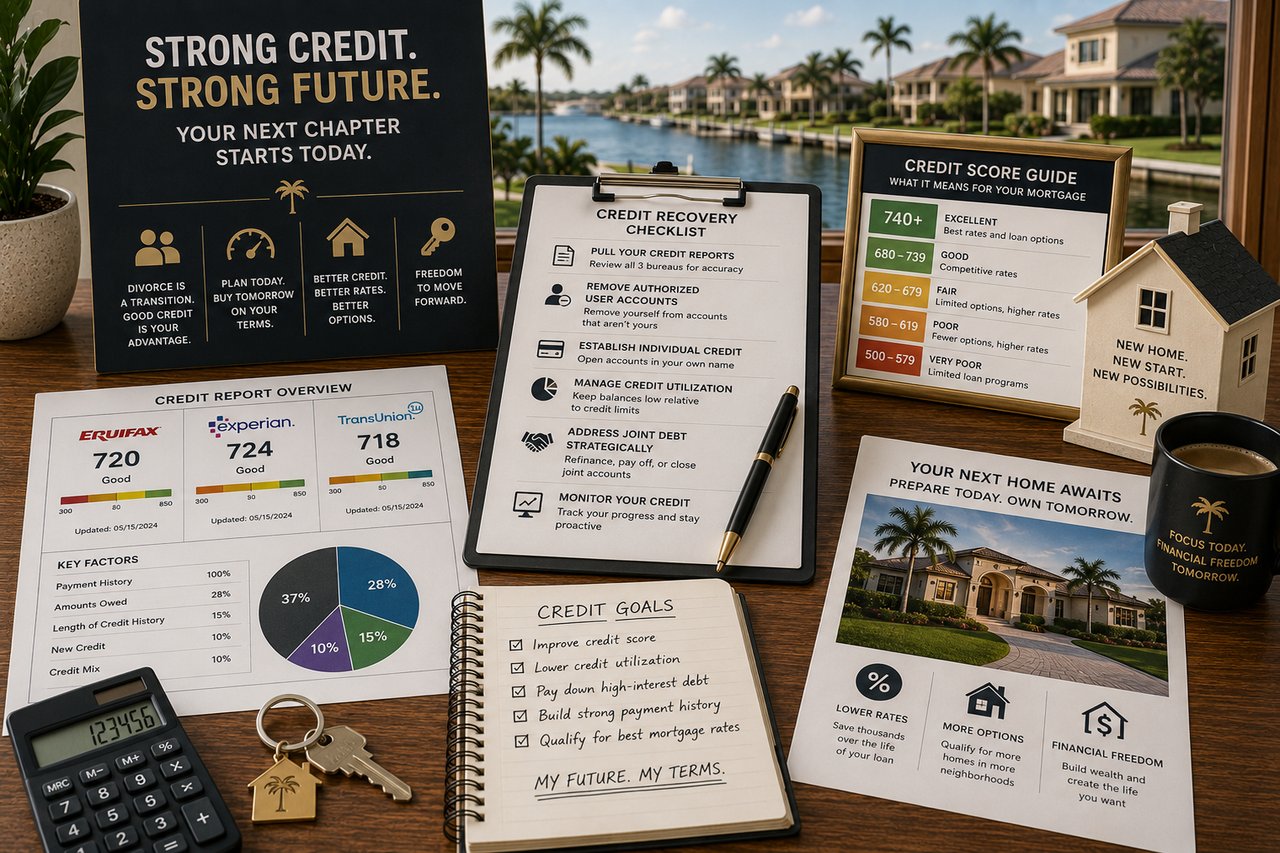
Divorce can affect your credit in several ways — some obvious, some not — and getting your credit profile in shape before buying again in Florida requires a specific, proactive approach. The sooner you start, the better your options when you are ready to buy. Here is what to address and how.
The Credit Conversation Nobody Has During Divorce
When couples going through a divorce focus on the real estate piece, the conversation is almost always about the marital home — who keeps it, how to buy out the other spouse, what it is worth, whether to sell. Rarely does anyone stop to talk about what happens to each person's credit profile during and after the divorce — and how that credit profile will affect their ability to buy their next home.
I work with divorcing clients throughout Southwest Florida, and the buyers I see who are ready to purchase again 12 to 24 months after a divorce are the ones who started managing their credit situation early in the process rather than after it was done. Here is what you need to know.
How Divorce Affects Your Credit — Even When You Do Everything Right
Joint Accounts and Authorized User Status
If you have joint credit accounts — credit cards, a home equity line of credit, or any other revolving credit — with your spouse, both parties remain equally responsible for those accounts until they are closed or refinanced into one person's name. If your spouse misses payments on a joint account after the divorce — or before it is finalized — those missed payments appear on your credit report too, regardless of what the divorce decree says about who is responsible for that account.
This is one of the most significant credit risks in a divorce situation: you did everything right, paid your own bills on time, and still had your credit damaged because your former spouse was late on a joint account you thought was their responsibility. The divorce decree allocates responsibility between the two of you — it does not change the contract between you and the lender.
The Credit Utilization Impact of Closing Accounts
Credit utilization — the percentage of your available credit that you are using — is one of the most important factors in your credit score. When joint accounts are closed as part of a divorce, your total available credit decreases, which can increase your utilization ratio and reduce your score even if your balances have not changed.
If you have $20,000 in available credit across three joint cards and $4,000 in balances, your utilization is 20 percent. If two of those joint cards are closed after the divorce, your available credit drops to $7,000 with the same $4,000 balance — now a 57 percent utilization ratio that will significantly hurt your score.
The Length of Credit History Impact
Closing old joint accounts also reduces the average age of your credit accounts, which is another factor in your credit score. If the joint accounts that are closed were your oldest accounts, the impact on your score can be meaningful. This does not mean you should keep harmful joint accounts open — but it is worth understanding the credit score impact of account closures so you can plan accordingly.
The Step-by-Step Credit Recovery Plan
Step 1: Pull Your Credit Reports Immediately
As soon as you know divorce is happening — before the process is complete — pull your credit reports from all three bureaus: Equifax, Experian, and TransUnion. You are entitled to a free report from each at AnnualCreditReport.com. Review them for all joint accounts, all authorized user accounts, and any negative items you were not aware of. This gives you a baseline and identifies the accounts that need attention.
Step 2: Remove Yourself From Authorized User Accounts That Are Not Yours
If you are an authorized user on your spouse's accounts — credit cards opened in their name where they added you as a user — remove yourself as an authorized user. These accounts can affect your credit if the primary cardholder misses payments after the divorce.
Step 3: Open Individual Credit in Your Own Name
If you do not already have credit accounts solely in your own name, open them now. A credit card in your name alone, even with a modest limit, begins building your solo credit history. The length of this individual credit history will matter when you apply for a mortgage.
Step 4: Address Any Joint Debt Strategically
Joint accounts that are allocated to your spouse in the divorce decree should be refinanced into their name only as quickly as possible — not just because of your ongoing legal exposure, but because of the credit risk. If your spouse cannot refinance a joint account into their name, the least-bad option is usually to pay it off and close it rather than leave it as a joint liability that can damage your credit on their payment history.
Step 5: Monitor Your Credit Actively
Set up credit monitoring — free options exist through many banks and services — so that any change in your credit report generates an immediate notification. This is particularly important in the period immediately following divorce when accounts are being sorted and closed, and when the risk of inadvertent negative reporting is highest.
When Are You Ready to Buy Again in SWFL?
The minimum credit scores for mortgage qualification in Florida range from approximately 580 for FHA loans to 620 to 640 for conventional loans. But minimum qualification is not the same as optimal financing. For the best rates available on a conventional loan, you want a score of 740 or higher. The difference between a 680 and a 740 score can represent several thousand dollars over the life of a SWFL mortgage.
Most divorcing buyers who proactively manage their credit from the beginning of the process are ready to buy again — with a strong credit profile — within 12 to 24 months of the divorce being finalized. Those who wait and address the credit situation only when they are ready to buy may find themselves waiting an additional 6 to 12 months for the score to recover to where they want it.
Ready to make your move in Southwest Florida? Let's talk.
Whether you're buying, selling, downsizing, managing an estate, or navigating a life transition — I'm here for that conversation.
Call or text: 727.638.1704
Email: [email protected]
Or reach out at theabreugroup.com
— Daniel
Frequently Asked Questions
Q: Does a divorce show up on my credit report?
No — the divorce itself does not appear on your credit report. What appears are your accounts and your payment history. The effects of divorce appear indirectly through account closures, changes in utilization, and any negative payment history on joint accounts. The divorce decree is a legal document, not a credit event.
Q: How long does it take to rebuild credit after divorce in Florida?
With proactive credit management starting at the time of separation, most people see meaningful credit score improvement within 6 to 12 months. Rebuilding from significant damage — multiple missed payments, high utilization — typically takes 12 to 24 months of consistent positive payment history to substantially recover. The sooner you start, the faster the recovery.
Q: Can I qualify for an FHA loan if my credit was hurt by a divorce?
FHA loans are available with credit scores as low as 580 with a 3.5 percent down payment, and some lenders will consider scores down to 500 with a 10 percent down payment. FHA loans are more accessible than conventional loans for buyers with imperfect credit and can be a legitimate path to homeownership in SWFL while your credit continues to recover. However, FHA loans require mortgage insurance premiums that add to the monthly cost compared to conventional financing.
Q: Should I pay off all my debt before buying again?
Not necessarily — the right balance depends on your debt-to-income ratio, your interest rates, and your down payment size. In general, paying off high-interest revolving debt improves your credit utilization and reduces your DTI, both of which help your mortgage qualification. Paying off low-interest installment debt like car loans has less direct benefit to your mortgage profile. A mortgage lender can model the impact of different debt payoff scenarios on your qualification and rate before you make decisions.
This post is intended for general educational and informational purposes only and does not constitute legal or financial advice. Divorce-related financial and credit matters involve complex intersections of family law, credit law, and financial planning that vary significantly based on individual circumstances. Nothing in this post should be relied upon as a substitute for advice from a licensed Florida family law attorney, a qualified credit counselor, or a financial advisor. Please consult with appropriate professionals before making any decisions.