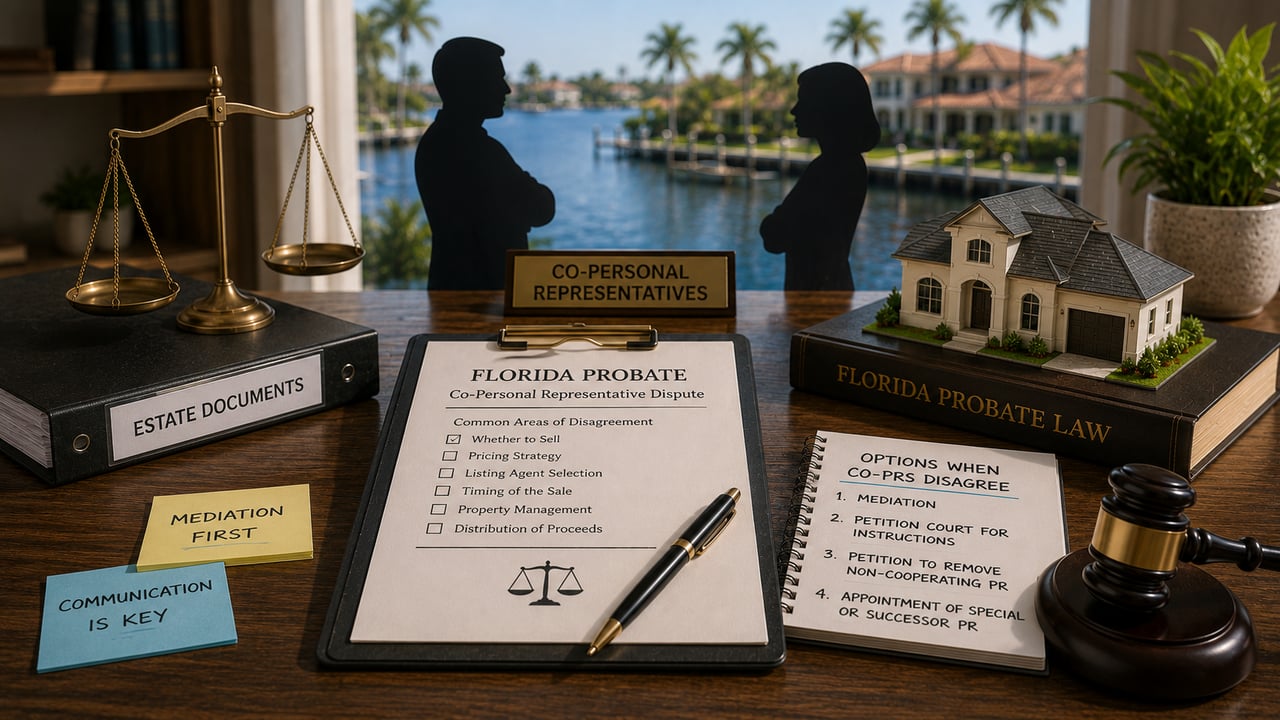
When two or more personal representatives in a Florida probate cannot agree on decisions about the estate's real property — whether to sell, how to price it, which agent to use, or when to list — the impasse creates real legal and financial consequences. Here is how Florida law addresses co-personal representative conflicts and what your options are when things break down.
Two Personal Representatives, One Property, and a Disagreement
It sounds like a reasonable idea when an estate plan is being drafted: name two of your children as co-personal representatives so that neither one bears the burden alone, and so that both families feel represented in the administration. In practice, co-personal representative arrangements — sometimes called co-executors — work smoothly when the parties have aligned interests, clear communication, and a shared sense of fiduciary responsibility.
When they do not have all three of those things, co-personal representative situations become some of the most difficult and costly estate administration scenarios I encounter in Southwest Florida. Siblings who stopped speaking years ago. Children from different marriages who have competing interests. One PR who lives in Florida and one who lives across the country. One who wants to sell immediately and one who wants to hold the property for sentimental reasons. These situations are real, they are common, and they have specific legal frameworks that govern how they get resolved.
How Florida Law Treats Co-Personal Representative Authority
The Default Rule: Joint Action Required
Under Florida Statute 733.615, co-personal representatives must act in concert on matters relating to the administration of the estate unless the will specifically provides otherwise. This means that for significant decisions — including the listing and sale of real property — both personal representatives generally must agree and both must sign the relevant documents.
The practical consequence of the joint action requirement is that a co-personal representative who refuses to cooperate can effectively block the sale of the estate's real property — at least in the short term. The non-cooperating PR does not have to have a good reason. Unreasonableness itself is not immediately actionable under the joint action default. But there are remedies, and they become increasingly available as the non-cooperation continues.
When the Will Provides Different Authority
Some wills specifically address co-personal representative authority, granting each PR independent authority to act on specific matters or designating a lead PR for real estate decisions. If the will grants independent authority or majority-rules authority, the co-PRs have more flexibility to act without unanimous agreement. Reviewing the specific language of the will with the estate's probate attorney is the first step in understanding the scope of each PR's authority.
The Options When Co-PRs Cannot Agree
Option 1: Mediation
Before resorting to court intervention, mediation is often the most efficient and least damaging path to resolution. A neutral mediator experienced in estate disputes can help the co-personal representatives identify their actual underlying interests — which are often different from their stated positions — and find a resolution that both parties can accept.
Mediation is private, faster than litigation, and typically far less expensive than contested court proceedings. For disputes that are primarily personality-driven or communication-driven rather than substantively opposed, mediation frequently resolves the impasse within one or two sessions. The probate attorney can coordinate the mediation process.
Option 2: Petition the Court for Instructions or Authority
Under Florida Statute 733.602, a personal representative may petition the probate court for instructions on any matter arising in the administration of the estate. If the co-PRs cannot agree on whether or how to sell the estate property, either PR can petition the court for an order directing the administration of that asset.
The court can issue an order instructing both PRs on the course of action to take, or in appropriate circumstances, can grant one PR the authority to act independently on specific matters when the other is being unreasonable. This is a more formal process than mediation but can produce binding guidance when informal resolution has failed.
Option 3: Petition to Remove the Non-Cooperating PR
If one co-personal representative is actively breaching their fiduciary duty — not merely disagreeing, but taking actions or refusing actions in bad faith, for personal gain, or in a way that is clearly harming the estate — the other PR, or any interested party, can petition the court for removal of that PR under Florida Statute 733.504.
Grounds for removal include: breach of fiduciary duty, incapacity, conflict of interest, failure to act, or other conduct that would be injurious to the estate. The removal standard is higher than mere disagreement — but sustained, bad-faith obstruction of estate administration can meet that standard. This is litigation and should be approached as a last resort after other options have been exhausted.
Option 4: Appointment of a Successor or Special PR
In cases where the co-PR conflict is so severe that estate administration has ground to a halt, the court may appoint a successor personal representative or a special personal representative to handle specific matters. A special PR has authority to act only on the specific matters for which they are appointed — such as the sale of the real property — while the original PRs continue with their other responsibilities.
The Real Estate Dimension: How I Help Navigate This
My legal background gives me a solid understanding of where these disputes stand legally and what options are realistically available. When I work with families in co-PR situations, I serve as a neutral resource for the real estate piece — providing a Comparative Market Analysis that both parties can rely on as objective data, helping facilitate the listing process once the legal authority question is resolved, and coordinating with both attorneys and both PRs to keep the transaction moving when the relationship dynamics are difficult.
In situations where the co-PRs have agreed to sell but disagree on pricing or process, a neutral agent who presents the market data clearly and without taking sides can sometimes break an impasse that would otherwise require formal legal intervention.
Ready to make your move in Southwest Florida? Let's talk.
Whether you're buying, selling, investing, managing an estate, or just want a straight read on the market — I'm here for that conversation.
Call or text: 727.638.1704
Email: [email protected]
Or reach out at theabreugroup.com
— Daniel
Frequently Asked Questions
Q: Can one co-personal representative sell the property without the other's consent in Florida?
Under the default joint action rule in Florida Statute 733.615, no — both co-personal representatives must generally consent to and sign documents for a real property sale. The exception is if the will specifically grants independent authority to act, or if a court order has granted one PR independent authority on specific matters. Acting unilaterally without authority can expose the acting PR to personal liability.
Q: What if one co-executor lives far away and is unresponsive?
Unresponsiveness is one of the most common practical problems in co-personal representative situations. The probate attorney can attempt formal written communication demanding a response within a specific timeframe. If the unresponsive PR continues to delay, the court can be petitioned for instructions or, in severe cases, for removal of the unresponsive PR. The key is documenting all communication attempts carefully from the beginning.
Q: How are co-personal representative fees divided in Florida?
The statutory fee for personal representative services in Florida is shared equally among co-personal representatives unless the will or a court order provides otherwise. If one PR is doing significantly more of the work, the court can adjust the fee allocation — but this requires a formal petition and evidence of the unequal contribution.
Q: Can we agree upfront to give one co-PR decision-making authority over real estate?
Yes — with the proper legal documentation. The estate's probate attorney can draft a written agreement between the co-personal representatives that allocates specific decision-making authority over designated estate assets. This agreement should be reviewed by the court and reflected in the estate administration records. Proactive authority allocation at the beginning of administration prevents most practical co-PR conflicts before they develop.
This post is intended for general educational and informational purposes only and does not constitute legal advice. The information provided here reflects general principles of Florida probate law and should not be relied upon as a substitute for advice from a licensed Florida attorney. Every estate is different, and the specific facts of your situation may lead to different legal outcomes. If you are dealing with probate, estate administration, or any related legal matter, please consult with a qualified Florida probate attorney before taking action.