Sanibel Island was significantly impacted by Hurricane Ian in September 2022 — but the island's recovery has been real, ongoing, and in many ways transformative for the real estate market. Buyers who understand what the post-Ian market actually looks like — the opportunities, the due diligence requirements, and the long-term fundamentals — are finding that Sanibel remains one of the most compelling coastal addresses in Florida.
Sanibel Four Years After Ian: An Honest Assessment
Hurricane Ian made landfall near Fort Myers Beach and Sanibel Island on September 28, 2022, as one of the strongest hurricanes ever to strike the continental United States. The storm's impact on Sanibel was severe — the causeway connecting the island to the mainland was damaged, properties throughout the island sustained significant wind and flooding damage, and the island's electrical and utility infrastructure required extensive repair.
Four years later, Sanibel Island's recovery is well advanced — but it is not complete, and the island that buyers encounter today is different in specific and important ways from the pre-Ian Sanibel. Understanding those differences honestly — not through the rose-colored lens of island nostalgia and not through the reflexive negativity of buyers who dismiss Sanibel because of Ian — is what allows for smart decision-making in this market.
What Has Changed and What Has Not
What Has Changed
The most visible change on Sanibel is the physical transformation of the island's built environment. Properties that sustained significant damage and were rebuilt or substantially renovated now feature current Florida building code construction — stronger roof-to-wall connections, impact windows, elevated foundations where applicable — that represents a meaningful improvement in resilience compared to older pre-Ian construction.
The commercial landscape has also changed — some of the restaurants, shops, and services that defined the island experience before Ian have not reopened or have reopened in different forms. The recovery of the commercial and hospitality infrastructure has been somewhat slower than the residential recovery, though significant progress has been made.
The insurance market for Sanibel properties reflects the post-Ian reality. Homeowners insurance and flood insurance for island properties are materially more expensive than pre-Ian levels, and some carriers have reduced their appetite for new policy issuance in Lee County coastal zones. Any buyer seriously considering Sanibel must obtain actual insurance quotes for the specific property before making an offer — the insurance cost is a significant component of total ownership cost.
What Has Not Changed
Sanibel's fundamental appeal has not changed. The island is still one of the most beautiful barrier islands on the Gulf Coast. The J.N. 'Ding' Darling National Wildlife Refuge — one of the most significant wildlife refuges in the eastern United States — is still there, still extraordinary, and still largely intact. The shelling beaches that made Sanibel world-famous are still producing remarkable shelling. The character of the island as a nature-oriented, low-density, community-minded destination has, if anything, been reinforced by the shared experience of recovery.
The geographic scarcity that drives long-term value on Sanibel has not changed either. The island is a barrier island with finite land, development regulations that limit density, and a community committed to maintaining its natural character. The supply of Sanibel real estate cannot be significantly expanded, and the demand — once the post-Ian uncertainty has fully resolved — will reflect the island's enduring appeal.
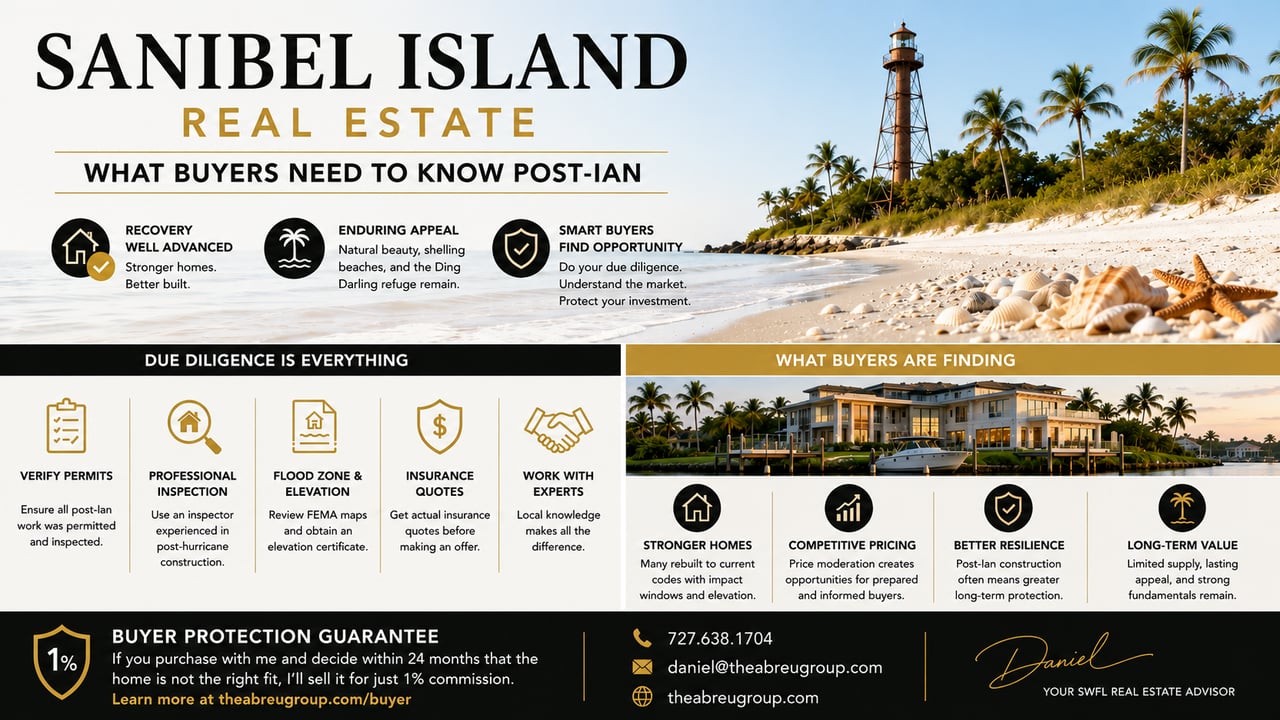
The Due Diligence Requirements for Post-Ian Sanibel Purchases
Verify the Construction Vintage and Post-Ian Work
For any Sanibel property, understanding what was done post-Ian and how it was done is the most critical due diligence item. Specifically:
- Obtain permits for all post-Ian repair and reconstruction work — permitted work was inspected to code, unpermitted work was not, and unpermitted construction on an island property creates both insurance and resale complications
- Request the contractor's information and any post-construction inspection documentation for significant structural work
- Commission a full home inspection by an inspector familiar with post-hurricane reconstruction — not all storm repairs are created equal, and a specialist inspector knows what to look for
- For substantially rebuilt properties, confirm whether FEMA's Substantial Damage determination was made — properties that sustained substantial damage may have been required to bring the entire structure into compliance with current flood elevation requirements
The Flood Zone and Elevation Certificate
Sanibel Island has extensive FEMA Coastal V and AE flood zones, reflecting the island's vulnerability to both storm surge and standard flooding. For any specific property, the flood zone designation and the structure's elevation certificate are essential documents that determine both the flood insurance requirement and the premium.
The post-Ian FEMA flood map updates for Lee County are worth reviewing for any Sanibel property under consideration — flood zone boundaries may have changed, and elevation requirements for rebuilt structures may differ from pre-Ian standards.
The Insurance Conversation Happens Before the Offer
I have said this in other posts and it bears repeating emphatically for Sanibel: get the insurance quote before you make an offer. Not a ballpark estimate — an actual quote from a licensed Florida insurer for the specific property's characteristics. On a Sanibel property, homeowners insurance and flood insurance together can run $15,000 to $40,000+ per year depending on the property's value, construction, elevation, and flood zone. That number needs to be factored into the total cost of ownership analysis before you fall in love with a property.
The Opportunity: What Smart Buyers Are Finding
The Sanibel market post-Ian has produced specific opportunities for buyers who approach it with the right knowledge and the right due diligence discipline. Newly rebuilt or substantially renovated properties — on current code, with impact windows, elevated foundations, and documented permits — represent a genuinely different risk and insurance cost profile from older pre-Ian construction. The post-Ian construction vintage, paradoxically, makes some Sanibel properties more resilient and more insurable than comparable coastal properties that were not rebuilt.
Buyers who have done their homework, who understand the insurance picture, who have a knowledgeable agent and a thorough inspection team, and who are committed to Sanibel for the long-term reasons that have always made it compelling are finding that the market rewards their preparation.
And here is something worth knowing before you buy: my Buyer Protection Guarantee means that if you purchase with me and decide within 24 months that the home is not the right fit, I will list and sell it for just 1% commission — no reason required. Real protection for a real commitment. Learn more at theabreugroup.com/buyer.
Ready to make your move in Southwest Florida? Let's talk.
Whether you're buying, selling, managing an estate, navigating a divorce, or simply want a straight read on the market — I'm here.
Call or text: 727.638.1704
Email: [email protected]
Or reach out at theabreugroup.com
— Daniel
Frequently Asked Questions
Q: Is Sanibel Island fully recovered from Hurricane Ian?
Recovery is well advanced but not fully complete as of 2026. The residential real estate market has seen significant activity — many properties have been rebuilt or renovated and are in excellent condition. The commercial and hospitality infrastructure recovery has been somewhat slower. The natural environment — the Ding Darling refuge, the beaches, the wildlife — has largely recovered and in some areas has benefited from reduced human activity during the recovery period.
Q: Are there good values on Sanibel right now compared to pre-Ian pricing?
The Sanibel market has seen price moderation since Ian that reflects both the lingering uncertainty about the island and the increased insurance and carrying costs. Buyers who are prepared to do thorough due diligence and who have a realistic understanding of the insurance cost picture are finding properties at prices that are competitive with pre-Ian levels on a per-square-foot basis — particularly for post-Ian construction that offers better resilience than the properties they are replacing.
Q: What types of properties should buyers avoid on Sanibel post-Ian?
Properties with unpermitted post-Ian repair work are the clearest red flag. Also approach with caution: properties where the scope of damage and the completeness of the repair is unclear, properties in the most vulnerable coastal V zones where storm surge risk is highest, and older construction that sustained significant damage but was repaired minimally rather than rebuilt to current standards. A thorough inspection and permit review tells the story.
Q: Does the Sanibel Causeway reliably provide access to the island now?
Yes — the Sanibel Causeway was repaired and reopened in late 2022, and it has been operating reliably since. The causeway's reconstruction incorporated improvements that address some of the vulnerabilities that contributed to its Ian damage. Access to the island is normal, and residents and visitors use the causeway without the disruption that characterized the immediate post-Ian period.