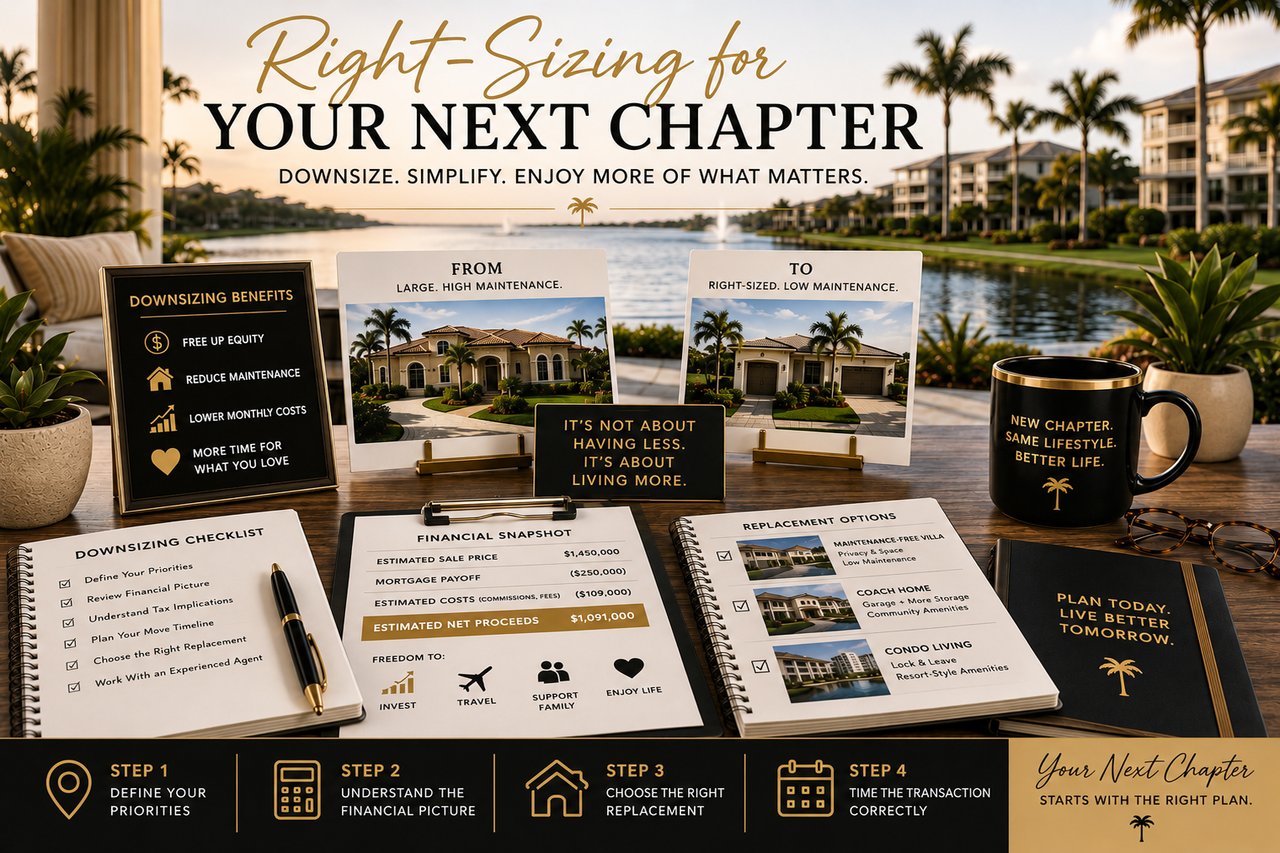
Downsizing in SWFL is one of the most common real estate moves in the region — and one of the most emotionally and logistically complex. Done right, it frees up equity, reduces maintenance burden, and opens a new chapter that can actually enhance the SWFL lifestyle rather than compromise it. Here is the strategic framework for doing it well.
Downsizing in SWFL Is Not About Giving Up — It Is About Right-Sizing
The word 'downsizing' carries connotations that do not fully capture what this move means for most Southwest Florida homeowners who make it. When a couple in their early 60s who raised their family in a 3,800-square-foot home in Pelican Landing decides to sell and move into a 2,200-square-foot coach home or a condo in the same community, that is not retreat. It is optimization. They are releasing equity from a home that was right for a family of four but represents more maintenance and more space than their actual daily life requires.
I have helped many SWFL homeowners navigate this transition — from large single-family homes to maintenance-free condos and villas, from gulf-front estates to well-appointed coach homes with community amenities, and from one SWFL community to another that better matches a changed lifestyle. The ones who do it well are the ones who start with a clear-eyed understanding of what they are actually optimizing for.
Step 1: Define What You Are Optimizing For
Before you look at a single property, answer these questions honestly:
- Maintenance burden: how much time and money are you currently spending on home maintenance, lawn care, pool service, and exterior upkeep — and how much do you want to spend going forward?
- Equity deployment: what do you plan to do with the equity you free up? Invest it? Fund travel? Support family members? The answer shapes how much equity release you want to prioritize.
- Space needs: be honest about how much space you actually use day to day versus how much you have. Most homeowners find that a 30 percent reduction in square footage is essentially imperceptible in daily life when the floor plan is well-designed.
- Lifestyle continuity: which aspects of your current home situation are most important to preserve — the golf, the community social structure, the beach access, the neighborhood? These are non-negotiables that should anchor the search.
- Geographic flexibility: are you open to moving to a different community or a different area of SWFL, or do you want to stay in your current community if a right-sized option exists there?
Step 2: Understand the Financial Picture Before You List
What You Will Net From the Sale
Before you start shopping for your next home, know what your current home will net after the mortgage payoff (if any), commissions, and closing costs. This gives you a clear equity pool to work with and prevents the common mistake of falling in love with a replacement property before you know whether the numbers work.
The Tax Implications of a Large Gain
If your SWFL home has appreciated significantly — and many have — the sale may generate a capital gain that exceeds the $250,000 per person ($500,000 for married couples filing jointly) exclusion available under the primary residence capital gains exclusion. Understanding your tax exposure before closing is essential. This is a conversation to have with your CPA before you list, not after you have already closed.
The Cost of the Replacement Home
Downsizing in SWFL does not always mean dramatically lower purchase prices. A well-appointed 2,200-square-foot condo in Pelican Bay or a maintenance-free villa in Bonita Bay might cost $700,000 to $1.2M — a meaningful price for a smaller space. The value is not in the lower price, it is in the lower carrying costs (no pool service, reduced or eliminated lawn care, reduced maintenance responsibility) and the equity release from the larger home. Model the full financial picture of the move, not just the price differential.
Step 3: Choosing the Right Replacement Property
Condo vs. Villa vs. Coach Home — What Actually Works for Downsizers
The most common replacement property types for SWFL downsizers:
- Maintenance-free villas: single-story attached or detached homes where the HOA covers exterior maintenance, landscaping, and sometimes the roof. These give you a house-like feeling — often with a screened lanai and small yard — without the full maintenance burden of a single-family home. Very popular with couples who want more space than a condo but fewer obligations than a large single-family.
- Coach homes: two-story attached residences, typically with a private garage, that offer more privacy and storage than a traditional condo. Common in communities like Bonita Bay, Pelican Landing, and many Naples communities. Good balance of space, community amenity access, and low maintenance.
- Mid-rise and high-rise condos: full maintenance-free living, often with resort-style amenity packages and the security of a staffed building. The trade-off is less private outdoor space. Popular for buyers who travel frequently or who want maximum lock-and-leave capability.
- Active adult communities: some SWFL communities offer active adult (55+) designated product that comes with programming specifically oriented toward that demographic. Worth considering if peer community culture is a priority.
The Community Continuity Question
One of the most strategically important decisions in a SWFL downsize is whether to stay within your current community if a right-sized option exists there. The social infrastructure, the relationships, the knowledge of the community culture — these have real value that is sometimes worth paying a modest premium to preserve. Many SWFL communities offer multiple product types within the same gates, and buyers who can downsize within their community avoid the disruption of rebuilding their social life in a new place.
Step 4: Time the Transaction Correctly
The SWFL downsizing transaction — selling a larger home and buying a replacement property simultaneously — is one of the more logistically complex transactions in the local market. The ideal sequencing is to sell first, then buy, which gives you certainty about your equity position and eliminates the contingency risk of needing to sell before you can close on the replacement. However, in communities where right-sized product is limited, being under contract on your current home before a replacement property comes available requires careful bridge financing or interim housing planning.
I help downsizing clients manage this sequencing challenge actively — coordinating the timing of the sale and the purchase to minimize the period of interim housing while ensuring the financial certainty the buyer needs to move confidently on the replacement property.
Ready to make your move in Southwest Florida? Let's talk.
Whether you're buying, selling, downsizing, managing an estate, or navigating a life transition — I'm here for that conversation.
Call or text: 727.638.1704
Email: [email protected]
Or reach out at theabreugroup.com
— Daniel
Frequently Asked Questions
Q: At what age do most people downsize in Southwest Florida?
The most common downsizing age range in SWFL is the early to mid-60s — typically when children have fully launched, the family home feels too large, and retirement or semi-retirement creates lifestyle priorities that do not require 3,500 square feet. However, there is no right age. I have helped buyers in their 50s who decided to right-size earlier, and buyers in their 70s or 80s making the move when health or lifestyle changes made it the right time.
Q: Should I sell my SWFL home before buying the replacement property?
In most cases yes — particularly in the current market where buyer contingencies (offers contingent on the sale of a prior home) are less competitive and where knowing your exact equity position gives you significant negotiating confidence. If a compelling replacement property comes up before you have sold, bridge loan financing or a flexible closing timeline on your current home can sometimes allow you to proceed — but these situations require careful financial planning.
Q: Can I keep my homestead exemption when I downsize to a smaller property?
You will need to re-apply for the homestead exemption on your new property by March 1st of the year following your purchase. The Save Our Homes portability benefit from your current home's assessed value can be transferred to your new home — up to $500,000 of accumulated benefit. Applying for portability at the time of your homestead exemption application on the new property preserves this benefit.
Q: How long does a typical SWFL downsize transaction take from listing to settled in a new home?
From the time you list your current home to the time you are settled in the replacement property, plan for 4 to 6 months as a realistic timeline. This includes the listing and sale process (typically 30 to 60 days to contract in a well-priced situation), the closing period (30 to 45 days), finding and contracting on the replacement property (variable), and the replacement closing. I work with downsizing clients to map out the full timeline so there are no surprises and the transition is as smooth as possible.