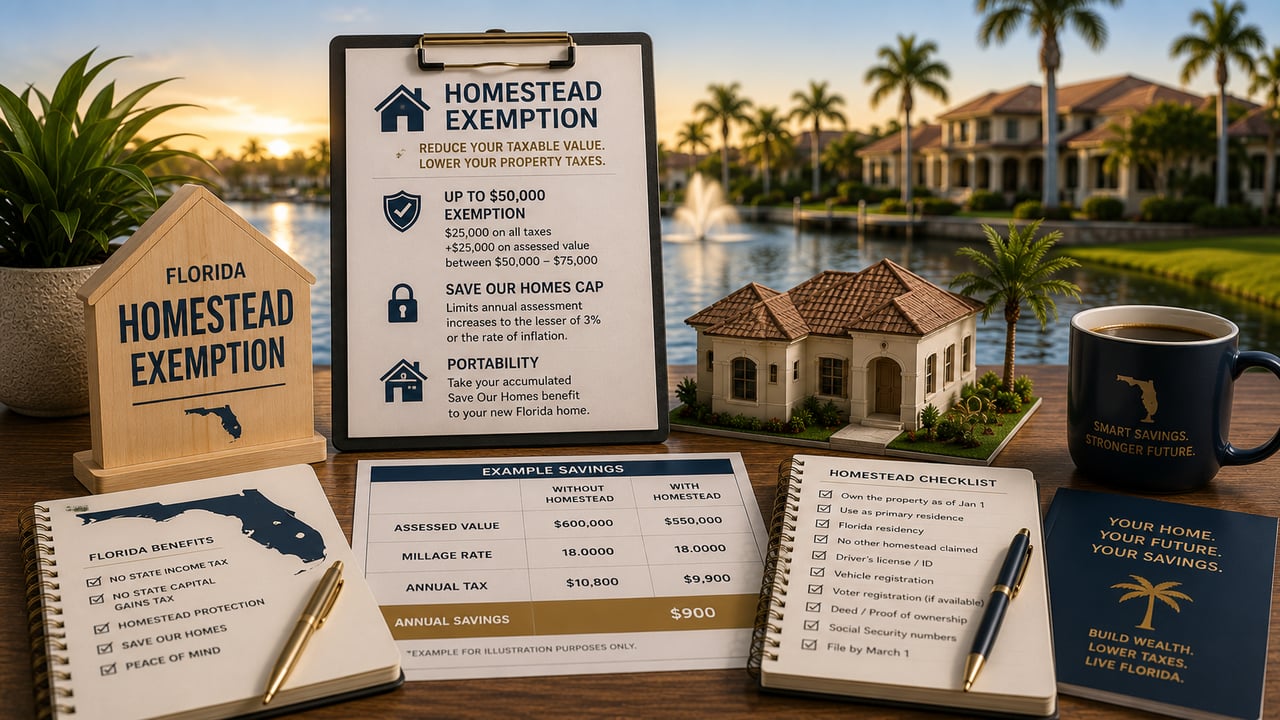
Florida's homestead exemption reduces the assessed value of your primary residence by up to $50,000 for property tax purposes — and the Save Our Homes cap limits how much your assessed value can increase each year after that. Combined, these protections can save SWFL homeowners thousands of dollars annually. Here is what they are, who qualifies, and how to apply.
One of the Best Financial Benefits of Owning in Florida — That Too Many Buyers Miss
When I work with buyers purchasing their first Florida property — particularly buyers relocating from states where the homestead exemption is less generous or does not exist — one of the pieces of information that generates the most genuine surprise is the scope of Florida's homestead exemption and how significant it is for their annual property tax bill.
A buyer who pays $600,000 for a home in Naples or Fort Myers as their primary residence and successfully applies for the homestead exemption will see their taxable assessed value reduced, their property tax bill meaningfully lower than their neighbor who owns a comparable investment property without the exemption, and a cap on future assessment increases that compounds into even greater savings over time. Here is exactly how it works.
The Homestead Exemption: The Basics
What It Is
Florida's homestead exemption, established in the Florida Constitution and codified in Florida Statute 196.031, allows eligible homeowners to reduce the assessed value of their primary residence by up to $50,000 for property tax purposes. The first $25,000 of the exemption applies to all ad valorem taxes including school board taxes. The additional $25,000 applies to assessed value between $50,000 and $75,000 and does not apply to school board taxes.
In practical terms, on a property with an assessed value of $600,000 in Lee or Collier County, the homestead exemption reduces the taxable value to approximately $550,000 (or $562,500 for school taxes), which at a combined millage rate of approximately 15 to 18 mills translates to a direct annual tax savings of $750 to $900 per year — every year.
Who Qualifies
To qualify for Florida's homestead exemption, you must:
- Own the property as of January 1st of the tax year for which you are claiming the exemption
- Occupy the property as your permanent, primary residence as of January 1st
- Be a Florida resident — maintain a Florida driver's license or state ID, Florida voter registration, and other indicators of Florida domicile
- Not claim a homestead exemption or residency-based tax benefit in any other state
Part-year residents, snowbirds who maintain primary residence in another state, and owners of rental or investment properties do not qualify for the homestead exemption on those properties.
Save Our Homes: The Cap That Builds Over Time
What It Is
The Save Our Homes assessment cap — also a Florida Constitutional provision — limits how much the assessed value of a homesteaded property can increase year over year. The cap is the lesser of 3 percent or the rate of inflation (measured by the Consumer Price Index). Once you have the homestead exemption in place, your property's assessed value for tax purposes can increase by no more than 3 percent per year regardless of how much the market value of your property increases.
This is enormously valuable in a market like SWFL that has experienced significant appreciation. A property purchased for $450,000 in 2018 that is now worth $750,000 in 2026 might have an assessed value of only $530,000 if the homestead exemption has been in place continuously — reflecting the 3 percent annual cap rather than the full market value increase. The property tax bill on that $530,000 assessed value is dramatically lower than it would be on the $750,000 market value.
The Portability Benefit
Florida homeowners who sell their homesteaded property and purchase a new primary residence in Florida can port their accumulated Save Our Homes benefit to their new home. This means the difference between your old home's assessed value and its market value at sale — called the portability amount — can be applied to reduce the assessed value of your new home, up to $500,000.
For long-term Florida homeowners with significant accumulated Save Our Homes savings, portability can result in substantial property tax savings on a new, higher-priced home. I always advise clients who are selling a homesteaded Florida property to apply for portability when purchasing their new home.
How to Apply for the Homestead Exemption in SWFL
The Deadline
The application deadline for the homestead exemption is March 1st of the tax year. If you close on your primary residence in July 2026 and want the homestead exemption to apply to your 2027 property tax bill, you must file your application by March 1, 2027. Applications filed after March 1st will not apply until the following year.
Where to Apply
In Lee County: the Lee County Property Appraiser's office, located at 2480 Thompson Street in Fort Myers, handles homestead exemption applications. The county also accepts applications online through the Property Appraiser's website at leepa.org.
In Collier County: the Collier County Property Appraiser's office at 3950 Radio Road in Naples handles applications. Online applications are available through the Property Appraiser's website at collierappraiser.com.
What You Need to Apply
The application requires documentation confirming your Florida residency and ownership:
- Florida driver's license or state-issued ID showing the property address
- Florida vehicle registration showing the property address
- Voter registration card if registered in Florida (not required but helpful)
- The deed or other proof of ownership
- Social Security numbers for all owners applying for the exemption
Additional documentation may be required for non-citizen permanent residents, trustees, or other specific ownership situations.
What Happens When You Sell — Homestead Loss and Re-Application
When a property is sold, the homestead exemption terminates. The new owner must apply for their own homestead exemption by March 1st of the year following their purchase if they intend to use the property as their primary residence. They do not automatically inherit the seller's exemption or Save Our Homes benefit — each new owner must establish their own.
This is one of the reasons that buyers transitioning from a rental or investment property to their first primary residence in Florida need to take the application deadline seriously. Missing the March 1st deadline by even one day means waiting a full additional year for the exemption to take effect.
Ready to make your move in Southwest Florida? Let's talk.
Whether you're buying, selling, downsizing, managing an estate, or navigating a life transition — I'm here for that conversation.
Call or text: 727.638.1704
Email: [email protected]
Or reach out at theabreugroup.com
— Daniel
Frequently Asked Questions
Q: Does the homestead exemption apply to condos in SWFL?
Yes — condominium units that serve as the owner's primary residence qualify for the homestead exemption on the same basis as single-family homes. The exemption applies to the unit's assessed value and the Save Our Homes cap applies equally. The only difference is that common areas and parking in a condo building are typically assessed separately through the condo association's assessment structure.
Q: Can I have a homestead exemption on my SWFL home and a vacation home elsewhere?
No — you can only claim a homestead exemption on one property nationwide. Florida requires that the property be your permanent, primary residence. Claiming a homestead exemption in Florida while also claiming a residency-based tax exemption or homestead protection in another state is a violation of Florida law that can result in back taxes, penalties, and interest.
Q: What happens to my Save Our Homes benefit if I do major renovations?
Major additions or improvements that increase the assessed value of your property can result in a reassessment of the improvement's value at current market rates, even if the underlying land and existing structure continue to benefit from the Save Our Homes cap. New construction added to a homesteaded property is typically assessed at its market value at the time of the permit's completion, with the cap applying to future increases from that new baseline.
Q: How much does the homestead exemption actually save in SWFL?
The direct annual savings from the $50,000 exemption depends on the property's assessed value and the combined millage rate in your specific location. In Lee and Collier Counties, combined millage rates typically run 14 to 20 mills depending on the municipality, school district, and special district assessments. At 18 mills, the $50,000 exemption saves $900 per year directly. The Save Our Homes cap — which limits annual assessment increases — creates additional savings that compound over time and can be worth tens of thousands of dollars per year in a market with significant appreciation.