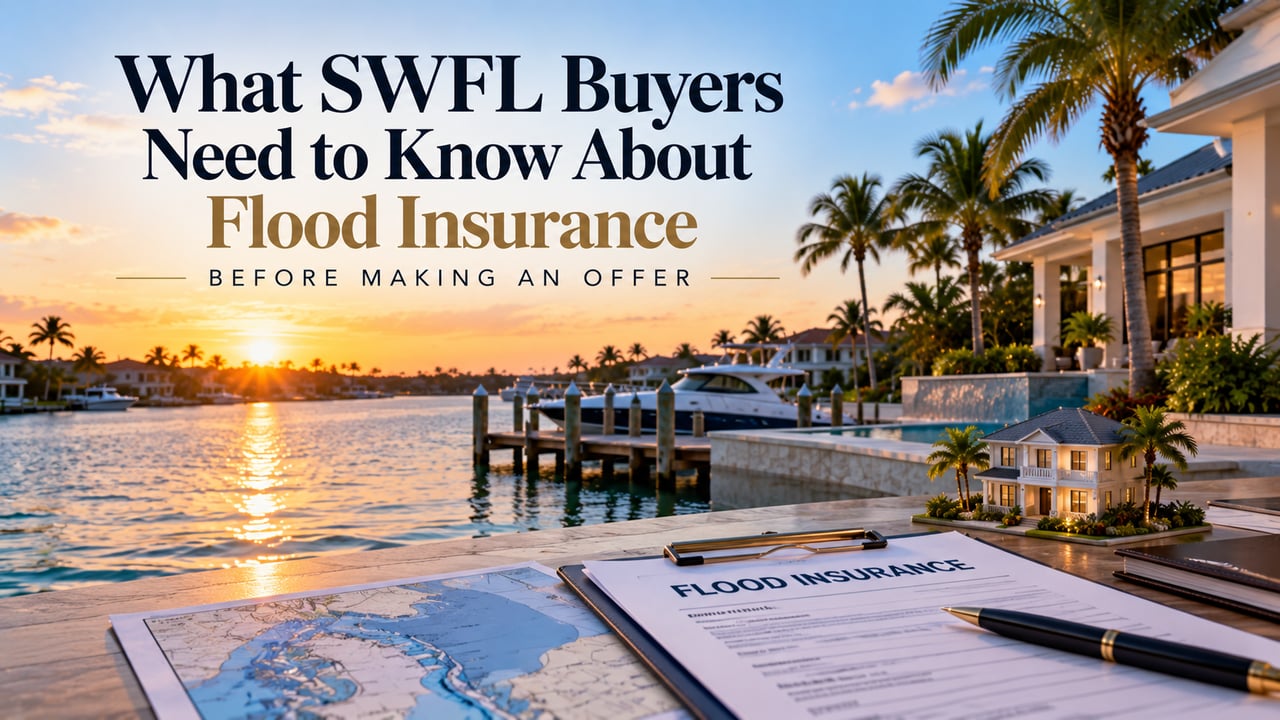
In Southwest Florida, flood insurance is not an optional add-on — it is a mandatory component of homeownership for most properties near the water, and the cost can range from a few hundred to tens of thousands of dollars per year depending on the property's flood zone and elevation. Every SWFL buyer needs to understand this before they make an offer, not after they are under contract.
The Number That Changes Everything — That Most Buyers Learn Too Late
In my experience helping buyers purchase homes throughout Southwest Florida, the moment that produces the most consistent shock is not the inspection report. It is not the closing disclosure. It is the flood insurance quote.
A buyer finds the perfect home in Cape Coral — a beautiful 3-bedroom canal home with a pool, asking $575,000. The neighborhood feels right. The inspection goes smoothly. The financing is approved. Then the flood insurance quote comes back: $8,400 per year for a property in FEMA Zone AE with older construction at a low elevation. That is $700 per month in flood insurance alone, on top of homeowners insurance, the mortgage, the HOA, and everything else. The total monthly cost of ownership is $800 per month more than they budgeted.
This discovery — after a buyer is already emotionally and contractually committed to a property — is one of the most avoidable surprises in SWFL real estate. Getting the flood insurance quote before making an offer, not after going under contract, is how you prevent it.
Understanding Florida's Flood Insurance Landscape
NFIP vs. Private Flood Insurance
Flood insurance in Florida comes from two sources: the National Flood Insurance Program (NFIP), administered by FEMA, and the private flood insurance market that has grown significantly in Florida over the last several years.
NFIP policies have historically been the dominant option for Florida homeowners, but they have specific characteristics that buyers need to understand:
- NFIP coverage limits: $250,000 for the structure and $100,000 for personal property. For homes worth more than $250,000 — which covers most of SWFL's market — NFIP provides only partial coverage. Excess flood coverage from a private carrier bridges the gap.
- NFIP Risk Rating 2.0: FEMA's current rating methodology, implemented in 2021, prices individual properties based on their specific flood risk rather than applying zone-wide rates. This means two neighboring properties can have dramatically different NFIP premiums based on their elevation, distance from water, and other individual characteristics.
Private flood insurance has become an increasingly viable alternative to NFIP for many SWFL properties, sometimes offering broader coverage, higher limits, and in some cases lower premiums. Getting quotes from both NFIP and private carriers for any serious purchase is the due diligence standard I recommend to every buyer client.
What FEMA Flood Zones Mean in SWFL
FEMA designates flood zones based on the probability of flooding in a given year. The zones most relevant to SWFL buyers:
- Zone VE: the highest-risk coastal zone, subject to wave action as well as flooding. Mandatory flood insurance required for any federally backed mortgage. Highest premiums. Found in beachfront and near-beachfront locations on barrier islands and Gulf-front properties.
- Zone AE: high-risk zone with 1 percent annual flood probability (the '100-year floodplain'). Mandatory flood insurance required for federally backed mortgages. Premiums vary significantly based on the property's elevation relative to the Base Flood Elevation. Found throughout SWFL's coastal and canal-adjacent areas.
- Zone X (Shaded/Moderate Risk): moderate risk zone. Flood insurance not federally required but strongly advisable — FEMA data shows that 20 to 25 percent of flood claims come from properties outside high-risk zones. Premiums are meaningfully lower than AE or VE properties.
- Zone X (Unshaded/Minimal Risk): lowest-risk designation. Flood insurance optional but available. Lowest premiums.
The Elevation Certificate: The Most Important Document You Have Never Heard Of
The elevation certificate is a survey document prepared by a licensed surveyor that documents a property's elevation relative to the Base Flood Elevation (BFE) — the FEMA-established flood level that the property is expected to experience in a 1-percent annual probability flood event. The elevation certificate is critical for two reasons:
First, it is required to get an accurate flood insurance quote. Without it, the insurer must assume the worst-case elevation scenario, which produces the highest possible premium. A property that is several feet above the BFE may have a significantly lower premium than the default assumption — but you cannot confirm this without the certificate.
Second, it documents the property's specific flood risk in a way that goes beyond the zone designation. A Zone AE property that is three feet above the BFE carries meaningfully different real flood risk than a Zone AE property that is one foot below it — and the elevation certificate is what distinguishes between them.
For any SWFL property in Zone AE or VE, I always recommend requesting the existing elevation certificate (if one exists) as part of the preliminary due diligence, and commissioning a new one if none is on file. The cost — typically $400 to $600 — is trivially small relative to the information it provides.
How to Run Flood Insurance Due Diligence Before You Make an Offer
- Step 1: Identify the flood zone using FEMA's Flood Map Service Center (msc.fema.gov) by address. This is free and takes two minutes.
- Step 2: Request the existing elevation certificate from the seller or the listing agent. If none exists, factor the cost of obtaining one into your decision process.
- Step 3: Contact a Florida-licensed flood insurance specialist — not just your homeowners insurance agent — for a quote that accounts for the specific property's flood zone, elevation, and construction characteristics.
- Step 4: Get both an NFIP quote and a private market quote to compare coverage and cost.
- Step 5: Factor the annual flood insurance premium into your total monthly cost of ownership calculation before you submit an offer.
This process takes a day or two and can be done before you make an offer. The information it provides can change your offer price, change whether you make an offer at all, or give you the informed confidence to proceed — all of which are better outcomes than discovering the insurance cost after you are already under contract.
And here is something worth knowing before you buy: my Buyer Protection Guarantee means that if you purchase with me and decide within 24 months that the home is not the right fit, I will list and sell it for just 1% commission — no reason required. Real protection for a real commitment.
Ready to make your move in Southwest Florida? Let's talk.
Whether you're buying, selling, managing an estate, navigating a divorce, or just want a straight read on the market — I'm here.
Call or text: 727.638.1704
Email: [email protected]
Or reach out at theabreugroup.com
— Daniel
Frequently Asked Questions
Q: Can I transfer the seller's existing flood insurance policy to me as the buyer?
NFIP policies are transferable to the new owner at the time of purchase — the buyer can assume the seller's existing NFIP policy, which may be beneficial if the policy was written before rate increases or if it has specific coverage characteristics that would be more expensive to replicate with a new policy. This option is worth exploring with a flood insurance specialist as part of your pre-offer due diligence.
Q: What is the maximum NFIP coverage available for a SWFL home?
The NFIP caps residential building coverage at $250,000 and personal property coverage at $100,000. For SWFL homes that are worth more than $250,000 — which covers most of the market — the NFIP alone is insufficient to fully cover replacement cost. Excess flood insurance from private carriers is available to cover the gap above the NFIP limits, and this excess coverage should be factored into your total insurance cost calculation.
Q: Does flood insurance cover damage from a hurricane's rain — or just storm surge?
Flood insurance covers rising water — storm surge, overflowing water bodies, and standing water from heavy rainfall that enters the home from the ground level. It does not cover wind damage or wind-driven rain that enters through a compromised roof or window. In a hurricane scenario, both types of damage can occur, which is why both flood insurance and a strong homeowners wind policy are essential in SWFL. The line between wind damage and flood damage is sometimes disputed in claims — having both policies from the same provider can simplify the claims process.
Q: How much does flood insurance typically cost in SWFL?
The range is genuinely enormous — from $500 to $600 per year for a Zone X property with a high elevation to $15,000 to $30,000+ per year for a Zone VE beachfront property or a Zone AE property with low elevation and high replacement value. The only way to know the actual cost for a specific property is to get an actual quote. General estimates based on zone alone are often meaningfully off from the property-specific number.