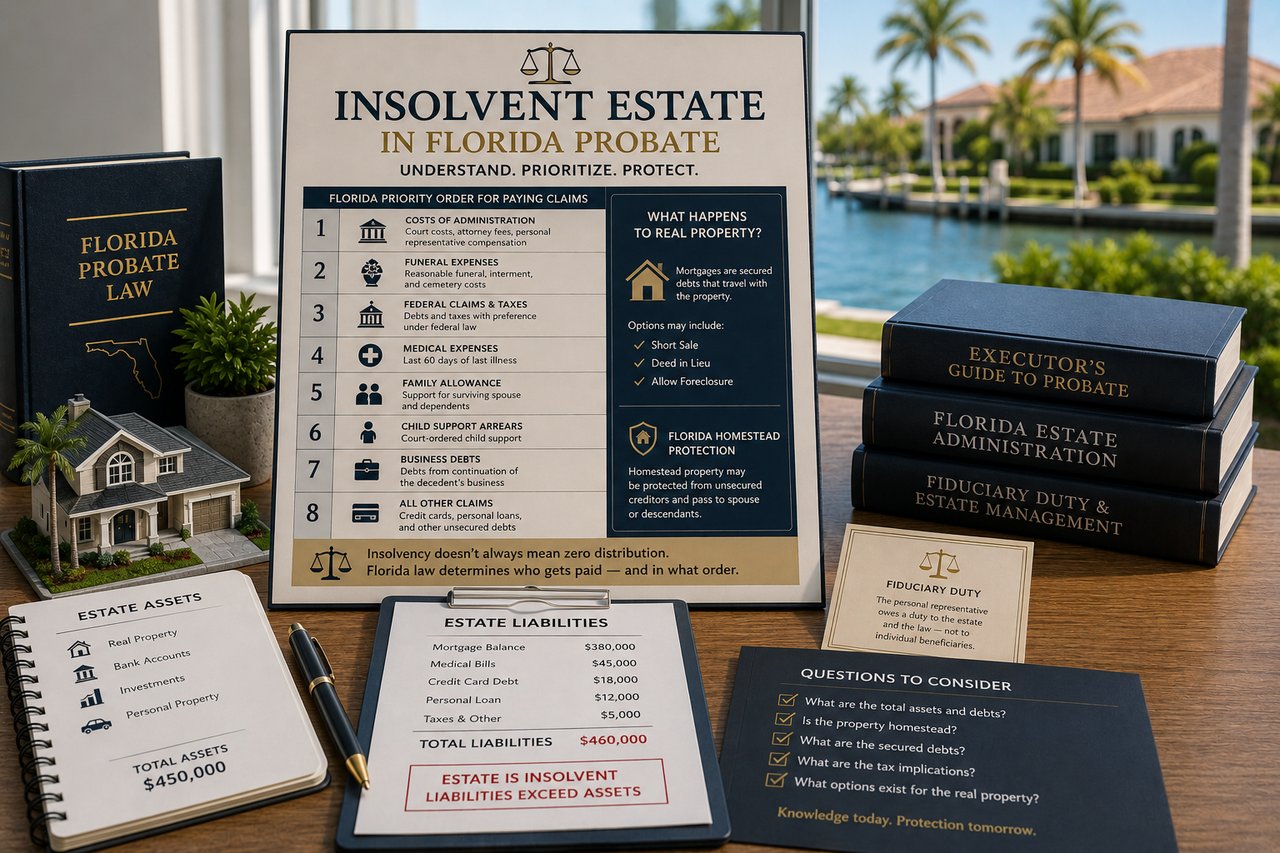
An insolvent estate is one where the debts and obligations exceed the value of the assets. In Florida probate, this situation triggers a specific legal framework for how assets are distributed and claims are paid — with strict priority rules that determine who gets paid first. If you are a personal representative or beneficiary facing this situation, here is what you need to know.
Insolvency in Probate Is More Common Than People Expect
When families come to me about inherited property in Southwest Florida, they sometimes discover that the estate is not what they expected — not because the property has no value, but because the debts attached to the estate are significant. An aging parent who took out a reverse mortgage on their Naples condo. A decedent who accumulated significant medical debt in their final years. An estate with a mortgage larger than the current property value in a softened market segment. These situations create what Florida law calls an insolvent estate — and they require a different approach than a standard probate administration.
Understanding what insolvency means in probate, how Florida law prioritizes creditor claims, and what happens to the real estate is essential for any personal representative navigating this situation. My legal background gives me a solid grasp of this framework, and here is how I explain it to families I work with in Lee and Collier County.
Defining Insolvency in Florida Probate
Florida Statute 733.707 defines the order of payment of estate obligations when the estate is insufficient to pay all claims in full. An estate is considered insolvent when its total assets are insufficient to satisfy all valid claims against it after applying the statutory priority order.
It is important to note that insolvency in probate does not mean zero distribution to beneficiaries in all cases — it means that the priority of payment among competing claims determines who gets paid and how much. Some beneficiaries may receive partial distributions; others may receive nothing. And some types of assets — notably Florida homestead property — have special treatment that affects the analysis.
The Florida Priority Order for Paying Estate Claims
Florida Statute 733.707 establishes a strict priority order for paying claims from an insolvent estate. In order from highest to lowest priority:
- Class 1: Costs, expenses of administration, and compensation of the personal representative — the estate's own administrative costs come first
- Class 2: Reasonable funeral, interment, and grave marker expenses, not to exceed statutory limits
- Class 3: Debts and taxes with preference under federal law, including federal income taxes and certain federal claims
- Class 4: Reasonable and necessary medical and hospital expenses of the last 60 days of the last illness of the decedent
- Class 5: Family allowance — Florida law provides a limited allowance to the surviving spouse and certain dependents
- Class 6: Arrearage from court-ordered child support
- Class 7: Debts acquired after death by the continuation of the decedent's business
- Class 8: All other claims, including credit card debt, unsecured personal loans, and most other obligations
In an insolvent estate, claims within each class are paid pro rata — if Class 8 creditors are owed a combined $200,000 but only $80,000 remains after higher-priority claims, each Class 8 creditor receives 40 cents on the dollar. Once assets are exhausted, remaining creditors in lower classes receive nothing.
What Happens to the Real Property in an Insolvent Estate
The Mortgage: A Secured Debt That Travels With the Property
If the estate's real property has a mortgage, that mortgage is a secured claim — it is not part of the unsecured creditor queue. The mortgage lender has a lien on the property itself, and that lien must be satisfied (or assumed) before the property can be transferred free and clear. In an insolvent estate where the property value is less than the mortgage balance, the personal representative faces a specific set of options:
- Short sale: selling the property for less than the mortgage balance with lender approval, which extinguishes the mortgage upon closing with a negotiated deficiency resolution
- Deed in lieu of foreclosure: transferring the property to the lender in exchange for release of the mortgage obligation, without going through the foreclosure process
- Allowing foreclosure: if the estate has no other assets and the personal representative cannot negotiate with the lender, allowing the lender to foreclose may be the only option
Each path has different timelines, credit implications for the estate, and tax consequences. The personal representative should work closely with both a Florida probate attorney and an experienced real estate professional when navigating these options.
Florida Homestead Protection: A Critical Variable
Florida's constitutional homestead protection provides significant protections for a decedent's primary residence, and those protections extend into probate in important ways. Under Florida law, the homestead property cannot be used to satisfy most estate creditors — it passes directly to the surviving spouse or to descendants outside of the probate creditor process in many situations.
This means that even in an insolvent estate, if the property is the decedent's homestead, it may be protected from unsecured creditors and may be available for distribution to family members even when other assets are not. The interaction between homestead protection and estate insolvency is one of the most complex areas of Florida probate law and requires careful attorney guidance to navigate correctly.
What Beneficiaries Should Understand
In a truly insolvent estate, beneficiaries may receive nothing — or significantly less than they expected. This can come as a devastating surprise when families discover the reality of the estate's financial position during administration. As difficult as this is, the personal representative's fiduciary duty runs to the estate and to the statutory priority of claims, not to the beneficiaries' expectations. The personal representative cannot distribute assets to beneficiaries before satisfying the estate's creditor obligations in priority order.
If you are a beneficiary of an estate that appears to be insolvent, the most important thing you can do is ensure that the personal representative is working with an experienced Florida probate attorney who understands the statutory framework. Distributions made out of order create personal liability for the personal representative.
Ready to make your move in Southwest Florida? Let's talk.
Whether you're buying, selling, investing, managing an estate, or just want a straight read on the market — I'm here for that conversation.
Call or text: 727.638.1704
Email: [email protected]
Or reach out at theabreugroup.com
— Daniel
Frequently Asked Questions
Q: Can beneficiaries be held responsible for an insolvent estate's debts?
Generally no — beneficiaries who receive distributions before the estate's creditors are properly paid can potentially be required to return those distributions (called a clawback), but beneficiaries are not personally responsible for the decedent's debts beyond the value of what they received from the estate. This is a significant protection that distinguishes heirs from general debtors.
Q: What is a reverse mortgage and how does it affect a Florida estate?
A reverse mortgage is a loan against the equity in a home that does not require monthly payments but becomes due and payable when the homeowner dies, sells the property, or no longer occupies it as their primary residence. When a homeowner with a reverse mortgage dies, the estate typically has approximately six months (with possible extensions) to either pay off the reverse mortgage or sell the property to satisfy the debt. If the property value is less than the reverse mortgage balance, the estate is only responsible for the lesser of the two amounts — reverse mortgages are non-recourse loans.
Q: Can a personal representative abandon estate property in Florida?
Yes — under Florida Statute 733.608, a personal representative may abandon any property that is burdensome or of inconsequential value to the estate. For property with negative equity (worth less than the debt secured against it), abandonment may be appropriate after following the required procedures. The personal representative must file a notice of intent to abandon with the court and provide proper notice to interested parties.
Q: What happens to the decedent's final income taxes in an insolvent estate?
Federal income taxes for the year of death are a Class 3 priority in Florida's insolvency framework — meaning they are paid before most unsecured creditors but after administrative costs and funeral expenses. If the estate lacks sufficient assets to pay federal taxes in full, the IRS has specific procedures for addressing partial payment from an insolvent estate. The estate's CPA and probate attorney should coordinate on this issue.
This post is intended for general educational and informational purposes only and does not constitute legal advice. The information provided here reflects general principles of Florida probate law and should not be relied upon as a substitute for advice from a licensed Florida attorney. Every estate is different, and the specific facts of your situation may lead to different legal outcomes. If you are dealing with probate, estate administration, or any related legal matter, please consult with a qualified Florida probate attorney before taking action.