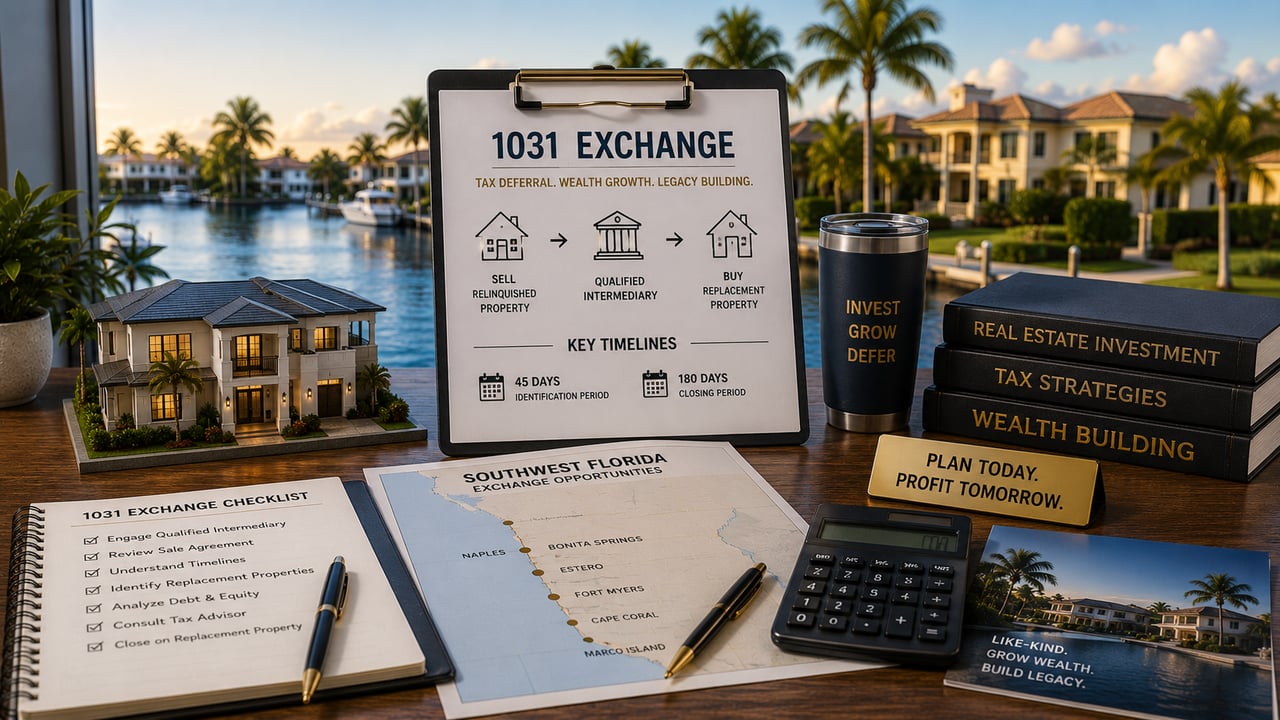
A 1031 exchange allows real estate investors to sell an investment property and defer capital gains taxes by reinvesting the proceeds into a like-kind replacement property within strict IRS timelines. Southwest Florida properties absolutely qualify — both as relinquished properties being sold and as replacement properties being purchased. Here is how it works and what you must get right.
One of the Most Powerful Tax Tools in Real Estate — and One of the Most Misunderstood
The 1031 exchange — named for Section 1031 of the Internal Revenue Code — is the tax deferral strategy that real estate investors talk about more than almost any other. And for good reason: on a property that has appreciated significantly, the capital gains tax that would be owed on a straight sale can be substantial — often 15 to 20 percent or more of the gain at the federal level, plus Florida has no state capital gains tax, which actually makes Florida a favorable state for this analysis.
The ability to defer that tax obligation by rolling the proceeds into a replacement property is a genuinely powerful wealth-building tool. But the rules are specific, the timelines are strict, and the mistakes that investors make — particularly around qualified intermediaries and the identification and closing deadlines — can be very expensive. Here is the framework every SWFL investor needs to understand.
The Basic Mechanics: How a 1031 Exchange Works
The Core Concept
In a standard property sale, you owe capital gains tax on the difference between your sale price and your adjusted basis (roughly, what you paid for it plus capital improvements, minus depreciation taken). A 1031 exchange allows you to defer that tax by reinvesting the proceeds into a 'like-kind' replacement property.
'Like-kind' does not mean the same type of property — it means the same nature or character. A single-family rental can be exchanged into a multi-unit apartment building, a commercial property, vacant land held for investment, or another rental property. What it cannot be exchanged into is a primary residence, a vacation home used primarily for personal use, or inventory property held for sale.
The Qualified Intermediary Requirement
This is the most critical operational requirement of a 1031 exchange and the most common source of fatal errors. You cannot receive the sale proceeds and then reinvest them — that destroys the exchange. The proceeds must go directly from the closing of your sale into a qualified intermediary's (QI) account, never touching your hands. You then identify your replacement property within the required timeframe, and the QI releases the funds to acquire it.
The QI must be engaged before the closing of the relinquished property sale — you cannot retroactively create a 1031 exchange after you have already received the proceeds. If you are considering a 1031 exchange, the first call is to a QI, not to a replacement property agent. Getting this sequence wrong is an irreversible mistake.
The Critical Timelines
The 45-Day Identification Period
From the date of closing on the relinquished property, you have exactly 45 days to formally identify the replacement property or properties you intend to acquire. This identification must be done in writing, delivered to the QI or another qualified party. The 45-day clock does not stop for weekends, holidays, or personal circumstances — it is absolute.
You can identify up to three properties under the standard three-property rule, or more properties under specific alternative identification rules. It is generally advisable to identify multiple properties rather than just one, in case your first choice falls through.
The 180-Day Closing Period
From the same date of closing on the relinquished property, you have 180 days to close on the replacement property. This 180-day period runs concurrently with the 45-day identification period — the 180 days begin on the same day, not after the 45 days end.
If you cannot close on the replacement property within 180 days, the exchange fails and the deferred tax becomes due. Extensions are not available except in very specific Federally declared disaster situations.
Does Southwest Florida Qualify for 1031 Exchanges?
Yes — absolutely, on both sides of the transaction. If you own a rental property anywhere in the country and want to exchange into a SWFL investment property, a well-selected Naples rental, a Cape Coral canal investment home, a Fort Myers multi-unit property, or a Marco Island vacation rental all qualify as legitimate like-kind replacement properties — provided they are held for investment purposes.
Similarly, if you own a SWFL investment property with significant appreciation and want to sell it and exchange into a larger investment property elsewhere in the country or into a different SWFL property type, the exchange works in that direction as well.
The SWFL market is particularly interesting for 1031 exchange buyers because of the appreciation track record for waterfront and coastal investment properties, the strong rental demand that supports the investment-use requirement, and the diversity of replacement property options across price points.
Common 1031 Exchange Mistakes in SWFL
- Engaging the QI after the sale has closed: the exchange is destroyed and cannot be recreated retroactively
- Missing the 45-day identification deadline by even one day: the exchange fails completely
- Identifying a primary residence or personal-use vacation home as the replacement property: these do not qualify
- Purchasing a replacement property for less than the net sale price of the relinquished property: any 'boot' — cash or debt reduction you receive — is taxable even in a valid exchange
- Using a QI who is not properly bonded and insured: the QI holds your proceeds, and QI fraud or insolvency has occurred in the industry
Ready to make your move in Southwest Florida? Let's talk.
Whether you're buying, selling, investing, managing an estate, or just want a straight read on the market — I'm here for that conversation.
Call or text: 727.638.1704
Email: [email protected]
Or reach out at theabreugroup.com
— Daniel
Frequently Asked Questions
Q: Can I do a 1031 exchange on my SWFL vacation home?
A vacation home that is used primarily for personal enjoyment does not qualify as investment property for 1031 exchange purposes. However, a property that is genuinely held for investment — rented out for most of the year with limited personal use — may qualify depending on the specific use pattern. The IRS has published safe harbor guidance on vacation property 1031 exchanges that requires at least 24 months of qualifying use before the exchange. Consult with a CPA or tax attorney before proceeding.
Q: What is the tax rate on capital gains from Florida real estate?
Florida has no state capital gains tax, which is a genuine advantage for Florida property owners. At the federal level, long-term capital gains (property held more than one year) are taxed at 0, 15, or 20 percent depending on your income level. There may also be a 3.8 percent net investment income tax for higher-income taxpayers. Additionally, depreciation previously claimed on the property is 'recaptured' at a 25 percent rate — this recapture is separate from the capital gain calculation and applies even in a 1031 exchange if the replacement property has less depreciable basis.
Q: Can I exchange into multiple replacement properties?
Yes — it is possible to exchange from one relinquished property into multiple replacement properties, provided you follow specific identification rules and meet the value requirements (the aggregate value of the replacements must equal or exceed the relinquished property's sale price, and the exchange debt on the replacements must equal or exceed the debt paid off in the sale). This is a more complex exchange structure that benefits from experienced QI and tax advisor involvement.
Q: How do I find a qualified intermediary for a SWFL 1031 exchange?
Qualified intermediaries are typically companies that specialize in exchange facilitation — they are not title companies, real estate agents, or attorneys (in fact, people in those roles who have a pre-existing relationship with you are specifically disqualified from serving as your QI). I can refer SWFL investors to QI firms I have worked with who are properly bonded, insured, and experienced with Florida real estate exchanges.
This post is intended for general educational and informational purposes only and does not constitute legal or financial advice. Real estate investment and tax strategies involve complex legal and financial considerations that vary based on individual circumstances. Nothing in this post should be relied upon as a substitute for advice from a licensed financial advisor, CPA, or real estate attorney. Please consult with appropriate professionals before making any investment or tax decisions.