Southwest Florida's vacation rental market has real income potential — but the gap between the dream and the reality is larger than most buyers expect. Management costs, insurance, seasonality, regulations, and operational complexity all affect the return. Here is the honest version of what vacation rental ownership in SWFL actually looks like.
Everyone's Seen the Numbers. Here's What They Don't Show You.
If you have spent any time researching vacation rental investment in Southwest Florida, you have probably seen projections that look something like this: a 3-bedroom waterfront home in Cape Coral earning $6,000 per week during season, 80 percent occupancy year-round, $150,000+ in annual gross revenue. These numbers are real — for the top-performing properties on the market. They are not typical. And the expense side of the equation is almost never shown alongside the income projection.
I work with vacation rental investors throughout SWFL — in Naples, Cape Coral, Fort Myers, Marco Island, and Bonita Springs — and I have seen both the success stories and the situations where the math did not work the way the buyer expected. This post is about giving you the complete picture so you can make an informed decision about whether a SWFL vacation rental makes sense for your situation.
The Income Side: What Is Realistic
The Location Hierarchy
In SWFL's vacation rental market, location is not just important — it is everything. The income differential between property categories is enormous:
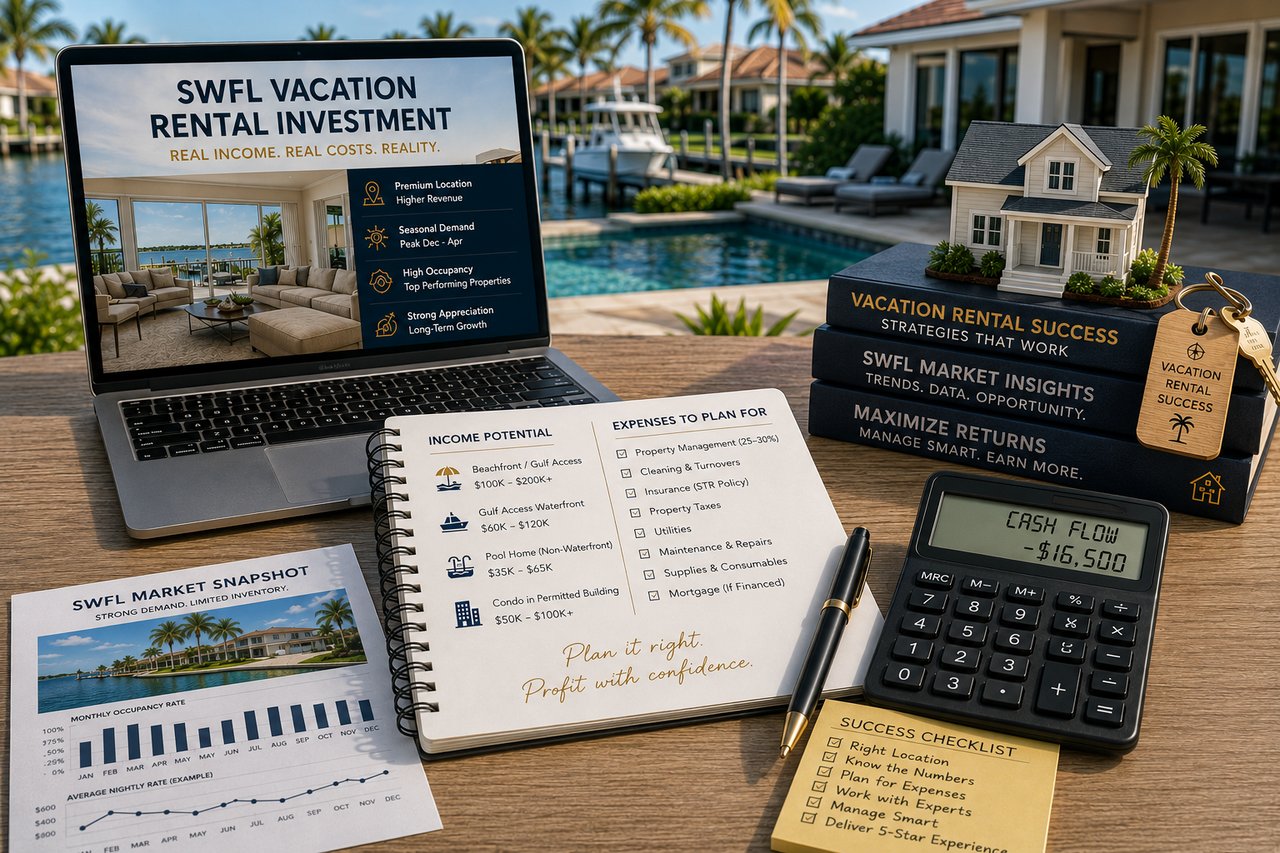
- Beachfront or direct Gulf access: the top tier. Nightly rates of $500 to $1,500+ for a quality 3/4-bedroom property in peak season, with annual gross revenues potentially reaching $100,000 to $200,000+ for a well-run property. But prices to acquire these properties are accordingly high — $1.5M to $5M+.
- Gulf-access waterfront (canal with boat access): still strong, particularly for buyers seeking the boat-behind-the-house lifestyle. Peak season rates of $300 to $700 per night for a 3/4 bedroom pool home. Annual gross revenues of $60,000 to $120,000 for a well-managed property in a desirable Cape Coral or Fort Myers location.
- Non-waterfront pool home in popular areas: rates of $150 to $350 per night in peak season, lower in summer. Annual gross revenues of $35,000 to $65,000 depending on location quality and property presentation.
- Condos in permitted STR buildings: highly variable by building, location, and unit quality. The strongest performing buildings in Naples and Marco Island can generate $50,000 to $100,000+ annually for premium units.
Seasonality Is Real and Significant
SWFL's vacation rental market is intensely seasonal. Peak season — December through April — is when the serious revenue is made. A property that books at $500 per night in February may book at $175 per night in August. Annual revenue projections need to be built on realistic seasonal occupancy curves, not on peak-season rates applied year-round. I always recommend building the income model month by month using actual comparable rental data rather than annual averages, because the seasonality is what determines whether the investment pencils.
The Expense Side: What Actually Comes Out
Here is the expense picture for a typical Cape Coral gulf-access pool home purchased at $650,000 and operated as a short-term rental:
- Property management (full service): 25 to 30 percent of gross revenue. On $90,000 in gross revenue, that is $22,500 to $27,000 per year. This covers listing management, guest communication, pricing optimization, check-in/out coordination, and issue resolution.
- Cleaning: $150 to $250 per turnover. At 80 turnovers per year (a reasonable occupancy estimate), that is $12,000 to $20,000. This is often separate from the management fee.
- Supplies and consumables: $3,000 to $6,000 per year for toiletries, linens replacement, paper goods, kitchen supplies, and general consumables.
- Homeowners insurance (STR policy): $7,000 to $14,000 per year. STR-specific policies are more expensive than standard homeowners policies and are essential — standard policies often exclude commercial rental activity.
- Flood insurance: $2,500 to $7,000 per year depending on flood zone and elevation.
- Property taxes: approximately $6,500 to $8,000 per year on a $650,000 assessed value in Lee County.
- Pool service: $200 per month, $2,400 per year.
- Lawn service: $150 per month, $1,800 per year.
- Utilities: Electric, water, cable, internet — the owner pays all utilities on a short-term rental. Budget $400 to $600 per month, $5,000 to $7,200 per year.
- Maintenance and repairs: budget 1 to 1.5 percent of property value annually — $6,500 to $9,750 for a $650,000 property.
- Mortgage payment (if financed): at 6.75 percent on a $487,500 loan (25 percent down), approximately $3,162 per month, $37,944 per year.
Total annual operating expenses before mortgage (reasonable estimate): $68,000 to $95,000. Total with mortgage: $106,000 to $133,000. On $90,000 in gross revenue, the cash flow is negative — the property is not self-funding at these assumptions with financing. This is the honest reality of most mid-range SWFL vacation rental investments in the current rate environment.
When the Math Does Work
The SWFL vacation rental math works best under specific conditions:
- Cash purchase or significant equity: removing or reducing the mortgage payment fundamentally changes the cash flow picture
- Top-tier location generating premium revenue: beachfront and prime gulf-access waterfront with $120,000+ in annual gross revenue changes the expense-to-income ratio
- The owner uses the property personally and values that use: if you are going to spend two months per year in your SWFL vacation rental, the lifestyle value is real and should be incorporated into your total return calculation
- Long-term appreciation thesis: in SWFL's historically appreciating market, particularly for waterfront and coastal properties, total return including appreciation often justifies cash-flow-negative operations in the short term
My Honest Recommendation
A SWFL vacation rental can be an excellent investment — but it is not a passive income vehicle for most buyers at current prices and interest rates. It is an active investment that requires active management, ongoing attention, and a return calculation that factors in the appreciation thesis alongside the income.
Before you buy a vacation rental in Southwest Florida, run a complete pro forma model with real numbers — not optimistic projections. Get actual comparable rental data for the specific property and location. Get real insurance quotes. Model the expense side honestly. And then decide whether the total return — income plus appreciation minus all costs — justifies the investment and the operational complexity.
Ready to make your move in Southwest Florida? Let's talk.
Whether you're buying, selling, investing, managing an estate, or just want a straight read on the market — I'm here for that conversation.
Call or text: 727.638.1704
Email: [email protected]
Or reach out at theabreugroup.com
— Daniel
Frequently Asked Questions
Q: Do I need a special license to operate a vacation rental in SWFL?
Yes. Florida requires vacation rental operators to hold a license from the Florida Department of Business and Professional Regulation. Lee County and Collier County both require local registration as well. The licensing and registration requirements include inspections and ongoing compliance obligations. Your property manager can typically handle this on your behalf, but the ultimate responsibility is the owner's.
Q: What is the difference between a vacation rental and a short-term rental?
In Florida, a vacation rental is specifically defined as a dwelling unit rented to guests for less than 30 days as a transient accommodation. A short-term rental is a broader term that encompasses vacation rentals. Both terms refer to the same category of use, and both trigger the Florida vacation rental license requirement and the associated sales tax and tourist development tax obligations.
Q: How do I know if a SWFL property is in a location where vacation rentals are allowed?
This requires verifying both the local government zoning and any applicable HOA or condominium association restrictions. Many SWFL communities, particularly in Naples, prohibit rentals under 30 or 90 days. Some restrict the number of rentals per year or require minimum stay periods. Always verify both the governmental and the HOA/condo restrictions for any specific property before making your purchase decision.
Q: What taxes do I owe on vacation rental income in Florida?
Vacation rental income in Florida is subject to Florida sales tax (6 percent plus applicable county surtax) and the local Tourist Development Tax (which varies by county — Lee County charges 5 percent, Collier County charges 5 percent). These taxes are collected from guests and remitted to the state and county. The rental income is also subject to federal income tax. A CPA with experience in short-term rental taxation can advise on deductions, depreciation, and the overall tax picture.
This post is intended for general educational and informational purposes only and does not constitute legal or financial advice. Real estate investment analysis involves financial, legal, and tax considerations that vary based on individual circumstances. Nothing in this post should be relied upon as a substitute for advice from a licensed financial advisor, CPA, or real estate attorney. Please consult with appropriate professionals before making any investment decisions.