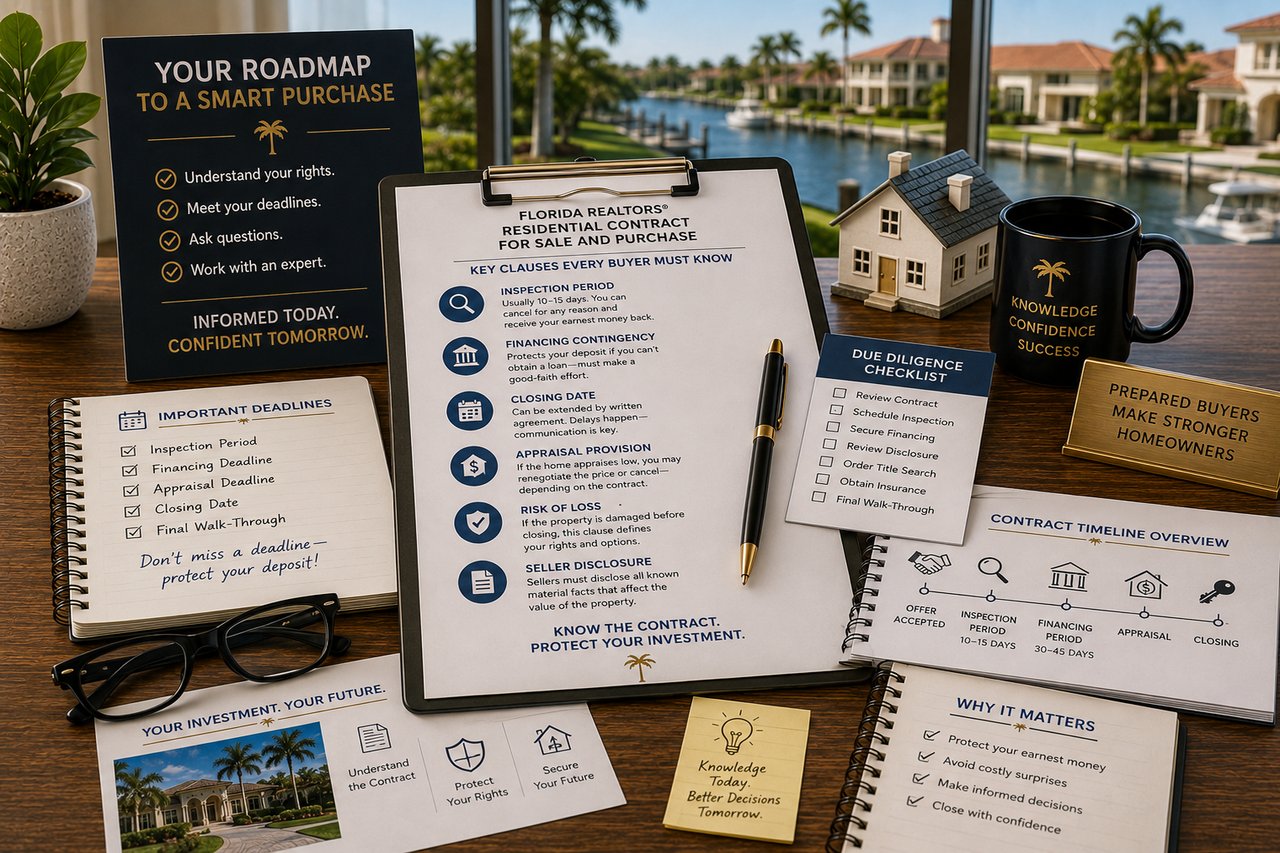
The Florida Realtors residential purchase contract governs nearly every aspect of a home transaction — from the inspection period to the financing contingency to what happens at closing. Most buyers sign it without fully understanding what they are agreeing to. Here are the provisions that matter most and what they mean for you.
The Contract Is the Transaction — Know What You're Signing
In Florida, the standard residential purchase and sale contract is the Florida Realtors/Florida Bar Contract for Sale and Purchase — a dense, multi-page document that covers everything from the earnest money to the closing date to what happens if the property is damaged before closing. Most buyers receive this document, review it briefly, sign it, and trust that their agent has explained the important parts.
That trust is often well-placed — but the buyers who understand the contract provisions themselves are in a genuinely better position than those who rely entirely on others. My legal background means I read every contract carefully, explain every meaningful provision to my buyer clients before they sign, and make sure they understand exactly what they are agreeing to. Here are the provisions that I consistently find most important to explain.
The Inspection Period: Your Most Powerful Protection
The Right to Cancel for Any Reason
The inspection period — typically 10 to 15 days in Florida residential contracts — gives the buyer the right to inspect the property and, in most standard contracts, to cancel for any reason whatsoever and receive a full refund of the earnest money. This right to cancel for any reason during the inspection period is extraordinarily broad and is the buyer's most powerful protection in the entire contract.
The key requirement is that the cancellation must be in writing, delivered to the seller or seller's agent before the inspection period expires. Missing the deadline by even a few hours can forfeit the right to cancel and put the earnest money at risk. I track inspection period deadlines obsessively for every buyer I represent — this is not a deadline you want to discover you missed after the fact.
What Happens After You Inspect
The inspection period also gives the buyer the opportunity to negotiate repairs, price reductions, or repair credits based on the inspection findings. The seller is not obligated to agree to anything in an as-is contract — but most standard contracts give the buyer the right to request repairs and the seller the right to respond. If the parties cannot reach agreement on the inspection findings during the inspection period, the buyer typically can either proceed without the requested repairs or cancel and receive their earnest money back.
The Financing Contingency: What Protects Your Deposit if You Can't Get the Loan
If your contract includes a financing contingency — which standard Florida contracts do unless waived — you are protected if you are unable to obtain a loan commitment by the financing deadline despite making a good-faith effort to do so. If your loan is denied through no fault of your own, you can cancel the contract and receive your earnest money back.
The critical details to understand:
- The financing deadline: typically 30 to 45 days after the effective date. Your loan commitment must be obtained by this date — not your closing date, your commitment date.
- Good faith effort requirement: the contingency protects you if you genuinely tried to get the loan. It does not protect you if you failed to apply promptly, failed to respond to lender requests, or took actions that sabotaged your own qualification.
- The definition of 'loan commitment': different contracts define this differently. Some require a full underwriting approval. Others accept a more preliminary commitment letter. Know which definition your contract uses.
The Closing Date: More Flexible Than It Appears
The contract specifies a closing date, but Florida contracts typically include language that both parties can agree to extend the closing date in writing. Delays happen — for appraisal issues, title issues, lender delays, or post-inspection negotiations — and most experienced agents and sellers know that a reasonable extension request is often granted rather than a default being declared.
However, the closing date is not simply advisory. If you cannot close by the contract date and the seller is not willing to extend, they may have the right to declare you in default and retain the earnest money. Understanding the closing date, keeping your lender on schedule, and communicating proactively if a delay is developing are all essential.
The Appraisal Provision: What Happens if the Property Doesn't Appraise
If you are financing your purchase, your lender will require an appraisal to confirm the property is worth at least the purchase price. If the property appraises below the purchase price, you have several options depending on your contract terms:
- In contracts with an appraisal contingency: you can typically cancel the contract and receive your earnest money back if the appraisal comes in below the purchase price and you and the seller cannot agree to a price reduction
- In contracts without an appraisal contingency (common in competitive offers): you are committed to closing at the contract price even if the property appraises lower — you would need to make up the difference between the appraised value and the purchase price in cash
Understanding whether your contract has an appraisal contingency — and whether you have waived it to make your offer more competitive — is critical. In today's SWFL market, buyers sometimes waive the appraisal contingency to compete. This is a meaningful financial risk that should be a conscious decision, not an overlooked one.
The Risk of Loss Provision: What Happens if the Property Is Damaged Before Closing
Florida contracts address what happens if the property is damaged between contract and closing — a genuinely important provision in hurricane territory. The standard Florida contract provides that if the property is damaged before closing and the cost of restoration exceeds a specified threshold, the buyer has the right to cancel and receive their earnest money back. Below that threshold, the sale typically proceeds and the seller is responsible for restoring the damage.
For buyers in SWFL, understanding this provision and making sure the seller's homeowners insurance is in force through closing is part of the due diligence package. A property that is uninsured at the time of a hurricane or storm event before closing creates complications that this provision is designed to address.
The Seller's Disclosure: What the Seller Must Tell You
Florida law requires sellers to disclose all known material facts that materially affect the value of the property and that are not readily observable by a careful inspection. The contract typically includes a seller's disclosure form where these facts are documented. Reading the seller's disclosure carefully — not just signing it as part of the paperwork stack — is essential. Discrepancies between what the seller discloses and what the inspection reveals are one of the most common sources of post-contract disputes.
Ready to make your move in Southwest Florida? Let's talk.
Whether you're buying, selling, investing, managing an estate, or navigating any real estate situation — I'm here for that conversation.
Call or text: 727.638.1704
Email: [email protected]
Or reach out at theabreugroup.com
— Daniel
Frequently Asked Questions
Q: What is the effective date of a Florida real estate contract?
The effective date is the date on which the last party signs or initials the contract — the date the contract becomes fully executed. Many of the contract's deadlines — the inspection period, the financing period, the closing date — run from the effective date rather than from a fixed calendar date. Knowing the effective date is essential for tracking all the contract's time-sensitive provisions.
Q: Can I back out of a Florida real estate contract after the inspection period?
Once the inspection period has expired, your ability to cancel without forfeiting the earnest money is limited to the specific contingencies remaining in the contract — primarily the financing contingency if your loan falls through despite good-faith efforts. A change of heart or cold feet after the inspection period expires does not entitle you to the return of your earnest money.
Q: What does 'time is of the essence' mean in a Florida contract?
Time is of the essence is a legal phrase in many Florida real estate contracts meaning that the specified deadlines are strict and material — missing a deadline is not a minor procedural issue but a contract violation with real consequences. When a contract says time is of the essence, the deadlines mean exactly what they say, and extensions require written agreement from both parties.
Q: Should I have a real estate attorney review the contract in Florida?
Florida does not require buyers to use an attorney in residential real estate transactions, but having an attorney review a contract — particularly for complex transactions, high-value purchases, or situations with unusual terms — is always an option and sometimes a wise one. My legal background allows me to explain contract provisions clearly and flag issues, but I am a real estate agent, not your attorney, and for specific legal questions, consulting a Florida real estate attorney is the appropriate step.