Cape Coral has over 400 miles of canals — more than any city on earth — but not all canals are equal. The difference between a gulf-access sailboat-depth canal and a freshwater drainage canal is a price difference of $200,000 or more and a completely different lifestyle. Here is everything buyers need to know before purchasing a waterfront property in Cape Coral.
Cape Coral's Canal System: The Feature That Defines the City
Cape Coral was literally built around its canal system. When Gulf American Land Corporation began developing the city in the late 1950s, they dug canals as the primary infrastructure — drainage, the visual appeal of water views, and the promise of a waterfront lifestyle accessible to the middle class. Today, with over 400 miles of navigable and non-navigable waterways, Cape Coral has more canal miles than any city on Earth — including Venice, Italy.
This canal infrastructure is why people move to Cape Coral. It is also why buying in Cape Coral requires more specific due diligence than buying in most other markets. Not all canals are created equal, the terminology can be confusing, and the difference between types of waterfront is more significant than it appears on a listing description. Here is the guide I give every buyer considering waterfront property in Cape Coral.
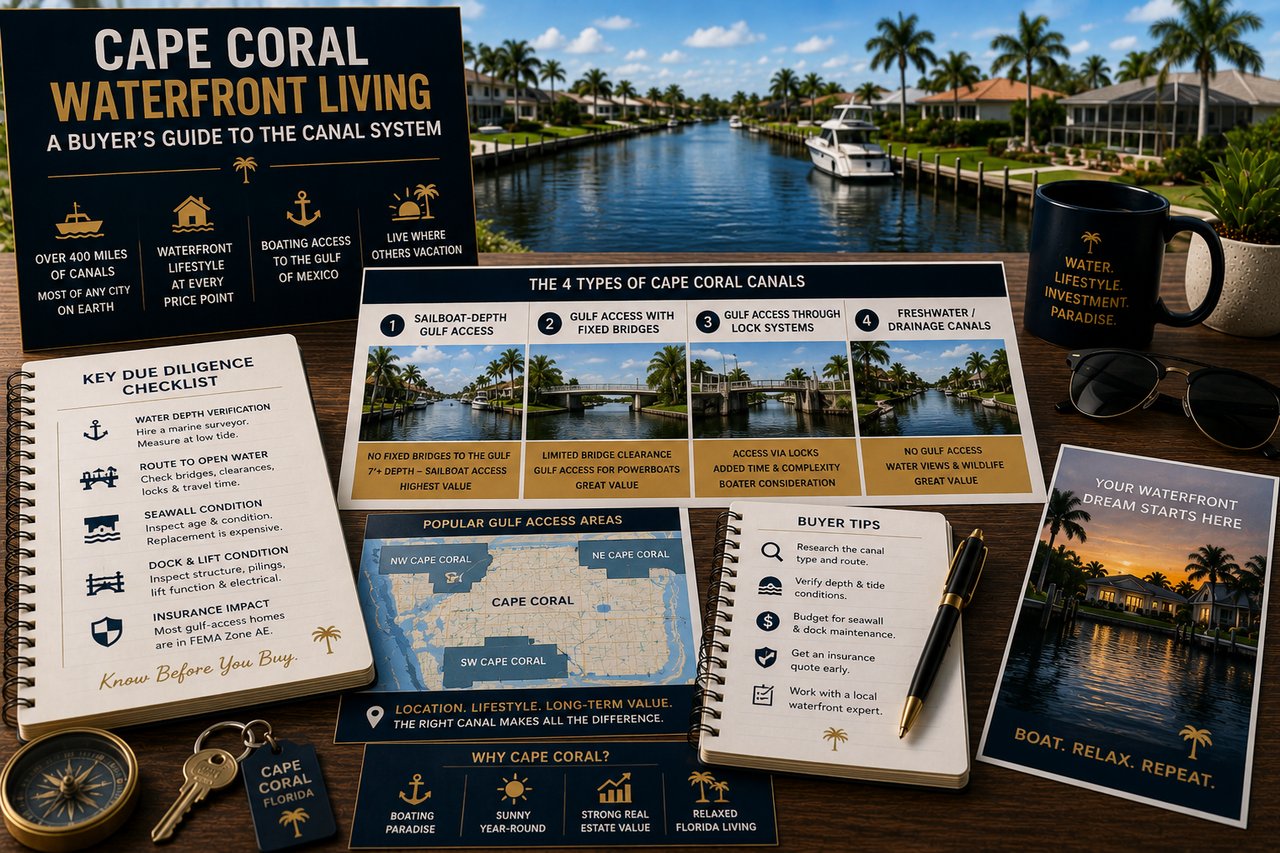
The Canal Hierarchy: Understanding the Four Main Types
Tier 1: Gulf-Access Sailboat-Depth Canals
These are the crown jewel of Cape Coral waterfront real estate. Gulf-access sailboat-depth canals have no fixed bridges between your dock and the open Gulf of Mexico, and they are deep enough to accommodate sailboats and larger motorized vessels — typically 7 feet or more at low tide throughout the route. From a sailboat-depth gulf-access canal in SW Cape Coral, you can dock a significant vessel behind your home and be in the Gulf of Mexico in approximately 20 to 30 minutes depending on your specific location.
This is the waterfront lifestyle that Cape Coral is famous for, and it commands the highest prices in the market. Homes on sailboat-depth gulf-access canals in desirable SW Cape Coral locations range from approximately $700,000 to $2M+ depending on home size, condition, lot dimensions, and canal width.
Tier 2: Gulf-Access With Fixed Bridges
Many of Cape Coral's gulf-access canals pass under fixed bridges with limited vertical clearance — typically 8 to 12 feet. These canals provide gulf access for boats that can navigate under those bridges — motorized boats, center consoles, and pontoons — but exclude sailboats and taller vessels. The boating lifestyle is genuine and appealing, but the vessel options are more limited.
Fixed bridge gulf-access properties typically trade at a meaningful discount to sailboat-depth access — often $50,000 to $150,000 less for otherwise comparable properties — which makes them an appealing value for buyers who prefer motorized boats anyway and do not need unlimited vertical clearance.
Tier 3: Gulf-Access Through Lock Systems
Some Cape Coral canals access the Gulf through the Spreader Canal lock system, which requires navigating locks that control water level and flow. The lock system is functional — boats pass through regularly — but it adds time and operational complexity to every trip to open water. Buyers who are serious boaters should understand the lock access experience before purchasing, as it is different from direct access canals.
Tier 4: Freshwater / Drainage Canals (Non-Gulf Access)
A significant portion of Cape Coral's canals are freshwater drainage canals with no connection to the Gulf. These canals are non-navigable for most powerboats and provide water views rather than water access. They are beautiful in many locations — wide, with attractive vegetation — but they are fundamentally different from gulf-access canals in lifestyle terms.
Freshwater canal properties in Cape Coral trade at a meaningful discount to gulf-access properties and appeal to buyers who want water views without the boating lifestyle or the insurance implications of gulf-access waterfront. It is critically important to understand which type of canal a property sits on before falling in love with a listing.
Key Due Diligence Items for Any Cape Coral Canal Property
Water Depth Verification
Do not assume the canal depth from the listing description or the agent's representation. Hire a marine surveyor to measure the actual depth at the dock at low tide for any property where boating access matters to you. Sediment accumulation, spoil disposal patterns, and canal maintenance history all affect actual depth. A canal listed as 'gulf access' that has shoaled to 3 feet at the dock at low tide is not practically navigable for most vessels.
The Route to Open Water
Know the full route from the property to open water. How many bridges are in the route, and what are their clearances? How long is the route, and what are the conditions along it (narrow sections, posted speed restrictions, heavy traffic areas)? Is the route through the Spreader Canal lock system? This is the single most important practical knowledge a boat-oriented Cape Coral buyer needs.
Seawall Condition and Age
Concrete seawalls are the primary waterfront boundary structure in Cape Coral, and they deteriorate over time — particularly in the salt-water canal environment. A seawall inspection by a licensed marine contractor is essential for any Cape Coral waterfront purchase. Seawall replacement costs $500 to $1,500 per linear foot, meaning a 100-foot seawall replacement is a $50,000 to $150,000 expense. Knowing the seawall's condition and remaining useful life before you buy is financially important.
Dock and Lift Condition
The dock and boat lift are significant assets that need their own inspection. Check the structural integrity of the dock decking, pilings, and framing. Verify that the boat lift functions correctly and is rated for the vessel you plan to use. Electrical systems on docks in the marine environment are subject to corrosion and require specific inspection.
The Insurance Implications of Cape Coral Waterfront
As covered in recent posts on flood zones and insurance costs, Cape Coral waterfront properties — particularly gulf-access canal properties — carry significant flood insurance obligations. Most gulf-access canal homes in SW Cape Coral are in FEMA Zone AE. Budget $3,000 to $8,000+ per year for flood insurance depending on the property's elevation certificate and the specific location. Get the actual insurance quote before making an offer.
Ready to make your move in Southwest Florida? Let's talk.
Whether you're buying, selling, investing, managing an estate, or navigating any real estate situation — I'm here for that conversation.
Call or text: 727.638.1704
Email: [email protected]
Or reach out at theabreugroup.com
— Daniel
Frequently Asked Questions
Q: How do I find out if a Cape Coral canal is gulf access?
The Cape Coral Canal Map is available from the City of Cape Coral and shows the full canal system with access classifications. Your agent should be able to pull this for any property under consideration. However, the map is a starting point — verifying the actual route, bridge clearances, and water depths through a marine survey is the definitive confirmation for serious boating buyers.
Q: What is a typical lot width on a Cape Coral canal property?
Standard Cape Coral residential canal lots are typically 80 to 125 feet wide. Wider lots command premium prices because they allow for longer dock configurations, wider turning radius for larger vessels, and in some cases two-boat lift setups. Corner lots at canal intersections are particularly desirable for their enhanced water views and dock flexibility.
Q: Do freshwater canal properties in Cape Coral allow kayaking and paddleboarding?
Yes — freshwater canals are perfect for kayaking, paddleboarding, and fishing from a canoe or kayak. They are also home to abundant Florida wildlife — herons, egrets, osprey, otters, and the occasional manatee in the brackish sections near the gulf system. For buyers who want an active water lifestyle without a powerboat, freshwater canal properties offer excellent value.
Q: Are there new construction options on Cape Coral canals?
Yes — Cape Coral still has new construction opportunities on existing canal lots throughout the city, though the most desirable sailboat-depth lots in SW Cape Coral are increasingly scarce. Both national builders and custom local builders are active in Cape Coral, and new construction on a canal lot allows buyers to get current building standards, modern finishes, and full warranty coverage with the waterfront lifestyle.