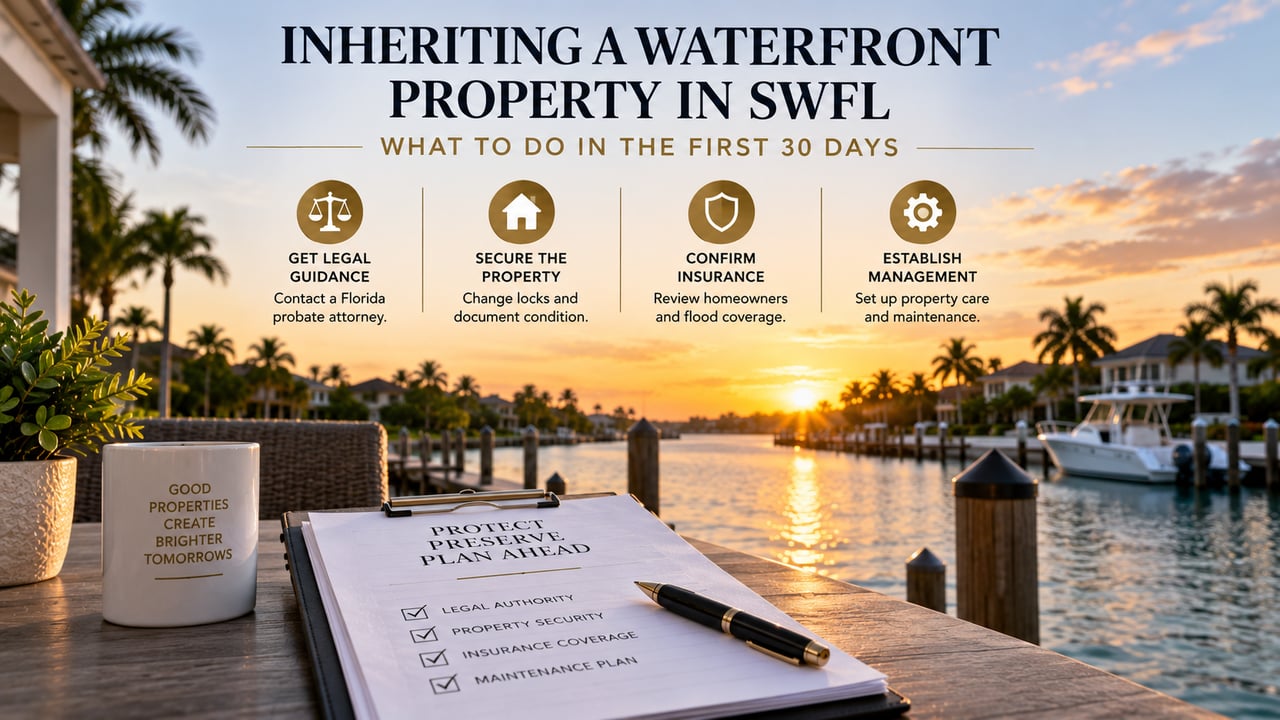
The first 30 days after inheriting a waterfront property in Southwest Florida are the most consequential for protecting the estate's value. Carrying costs begin immediately, the property faces specific weather and maintenance risks, and early decisions about legal authority, insurance, and property management shape the entire administration process. Here is the action plan.
The First Month Sets the Tone for Everything That Follows
When a loved one passes away and leaves behind a waterfront property in Southwest Florida — a canal home in Cape Coral, a bay-front estate in Naples, a Gulf Harbour residence, a Pelican Landing villa on the water — the grief of the loss and the complexity of the probate process can make it easy to let time pass before taking action on the property itself. That delay is understandable. It is also expensive.
Waterfront properties in SWFL have specific vulnerabilities that make prompt attention more important than for an inland home. The marine environment, the salt air, the humidity, the potential for weather events during hurricane season, and the ongoing costs of maintaining a boat dock and seawall mean that a waterfront property that goes unattended for even a few months can develop problems that cost far more to address than they would have to prevent.
This is the 30-day action plan I walk every family through when they inherit a SWFL waterfront property. It is organized by urgency — the things that need to happen in the first week, then the first two weeks, and then through the end of the first month.
Days 1 Through 7: The Immediate Priorities
Contact a Florida Probate Attorney
Before you take any other significant action, contact a Florida-licensed probate attorney. You need to understand how the property is titled — is it in the decedent's name alone, in a trust, in joint tenancy with right of survivorship? — because the answer determines what legal authority you need and how quickly you can move. If the property is in a revocable living trust, the successor trustee can act immediately without court proceedings. If it requires probate, you need to begin the petition process without delay.
The probate attorney is not someone you contact after you have figured everything out. They are the first call, because everything else depends on understanding the legal framework.
Secure the Property
Whether or not you have formal legal authority yet, taking reasonable steps to secure the physical property is appropriate and necessary. Change the locks to prevent unauthorized access by people who previously had keys — contractors, property managers, housekeepers, neighbors. Make sure the alarm system, if any, has updated access codes. Document the property's current condition with a thorough video walkthrough, paying specific attention to:
- The condition of all dock structures, boat lifts, and seawalls — waterfront infrastructure deteriorates quickly when not maintained and can become a safety hazard and a significant expense
- The condition of the pool and pool cage if present
- The overall interior condition — any signs of water intrusion, mold, or damage that may have preceded the owner's death
- The current state of all mechanical systems — HVAC, water heater, electrical panel
This documentation protects the estate by establishing a baseline condition record before any work begins.
Confirm and Maintain Insurance Coverage
Contact the decedent's homeowners insurance carrier immediately to notify them of the owner's death and confirm that coverage remains in effect. Many homeowners insurance policies have vacancy provisions — after a specified period of vacancy (commonly 30 to 60 days), coverage may be limited or certain types of claims may be excluded. Understanding what your current policy covers and whether you need to purchase a vacancy endorsement or a different policy structure is an urgent first-week task.
For waterfront properties, confirm that flood insurance is current as well. Flood insurance is a separate policy from homeowners insurance, and a lapse in flood coverage during a storm event before the estate is settled could produce a catastrophic uninsured loss.
Days 8 Through 14: Establishing Ongoing Management
Engage Property Management or Designate a Local Contact
If you do not live in Southwest Florida, arranging for a local property manager or a trusted local contact to oversee the property is essential before you leave. A waterfront property needs regular attention: pool and dock maintenance, lawn care, interior climate monitoring, and the ability to respond quickly to any storm watches or maintenance emergencies. The cost of property management — typically $150 to $300 per month for a basic oversight arrangement — is entirely justified by the expense of problems that go undetected because no one is checking.
During hurricane season — June through November — the property management arrangement should explicitly include a hurricane preparation protocol: who has the authority and the responsibility to close storm shutters, bring in dock lines, secure loose items, and document the property before and after a storm event.
Get a Professional Property Assessment
Within the first two weeks, commission a professional home inspection and, for any waterfront property, a separate seawall and dock inspection by a licensed marine contractor. These assessments serve two purposes: they identify any urgent maintenance issues that need to be addressed to protect the estate's value, and they create the documented baseline that you will need for the estate administration and the eventual listing.
For properties in communities like Gulf Harbour, Pelican Bay, or Bonita Bay — where the waterfront infrastructure includes marina slips, shared dock facilities, or community seawalls — coordinate with the community's property management about the status of any marina memberships, slip assignments, or community waterfront maintenance programs that were in effect.
Days 15 Through 30: Setting the Estate Administration in Motion
Run a Preliminary Title Search
Ask your probate attorney to order a preliminary title search as soon as the estate is opened. This search will surface any recorded liens, HOA arrears, unpaid taxes, or other encumbrances against the property that need to be addressed before it can be sold with clear title. For waterfront properties, pay specific attention to any recorded easements — public access easements, neighbor dock easements, utility easements — that affect the property's use and marketability.
Contact a Real Estate Professional Who Knows Both Probate and Waterfront
The estate does not need to be legally closed or the listing actively launched for this conversation to happen. Contact a real estate professional who has experience with both the probate process and the SWFL waterfront market — because these are genuinely different domains and most agents specialize in one or the other, not both. This early conversation serves several purposes: establishing a realistic market value picture for the estate accounting, understanding the optimal timing for a listing relative to the legal timeline and the seasonal market, and beginning the preparation process so the property is ready when legal authority is confirmed.
My legal background and my SWFL waterfront market experience make me well-positioned for exactly this conversation. Families who engage me early — before the property is ready to list — consistently achieve better outcomes than those who wait until every legal step is complete before starting the real estate process.
One more thing worth knowing: my Guaranteed Sale Program means your home sells in 60 days — or I eat my commission. No gimmicks, no long contracts. Just a clear performance commitment backed by real marketing execution. Learn more at theabreugroup.com/seller.
Ready to make your move in Southwest Florida? Let's talk.
Whether you're buying, selling, managing an estate, navigating a divorce, or just want a straight read on the market — I'm here.
Call or text: 727.638.1704
Email: [email protected]
Or reach out at theabreugroup.com
— Daniel
Frequently Asked Questions
Q: What if the waterfront property has a boat in the water — what do we do with it?
Secure the vessel immediately — ensure dock lines are sound, the bilge pump is functioning, and the boat is not taking on water. Notify the marina or dock master if the vessel is in a marina slip. For vessels with significant value, contact a marine insurance professional to understand the estate's coverage and liability. If the vessel is beyond the estate's practical ability to maintain, it may need to be hauled out or sold early in the administration process.
Q: Can we use the waterfront property during the probate process?
Generally yes, with appropriate authority from the personal representative and the estate's legal structure. However, the estate's insurance coverage during occupancy needs to be confirmed — occupancy by heirs or beneficiaries may or may not be covered under the existing homeowners policy without modification. Check with the insurance carrier before anyone stays in the property during the administration period.
Q: What if the waterfront property has an active tenant?
The tenant's lease survives the owner's death and must be honored by the estate. The personal representative steps into the landlord's shoes for the duration of the lease. The tenant should be notified in writing of the ownership change and provided with updated contact information for maintenance and rent payment. Florida landlord-tenant law applies to the estate's landlord obligations just as it would to any other landlord.
Q: How do we handle a boat slip in a marina that was leased by the decedent?
Boat slip leases do not automatically transfer to heirs — the marina's lease agreement and the terms for assignment or transfer need to be reviewed. Some slips can be transferred to heirs or to a subsequent property owner; others require a new application and may involve a waitlist. Contact the marina management early in the administration process to understand the options before the lease lapses.
This post is intended for general educational and informational purposes only and does not constitute legal advice. The information provided here reflects general principles of Florida probate law and should not be relied upon as a substitute for advice from a licensed Florida attorney. Every estate is different, and the specific facts of your situation may lead to different legal outcomes. If you are dealing with probate, estate administration, or any related legal matter, please consult with a qualified Florida probate attorney before taking action.