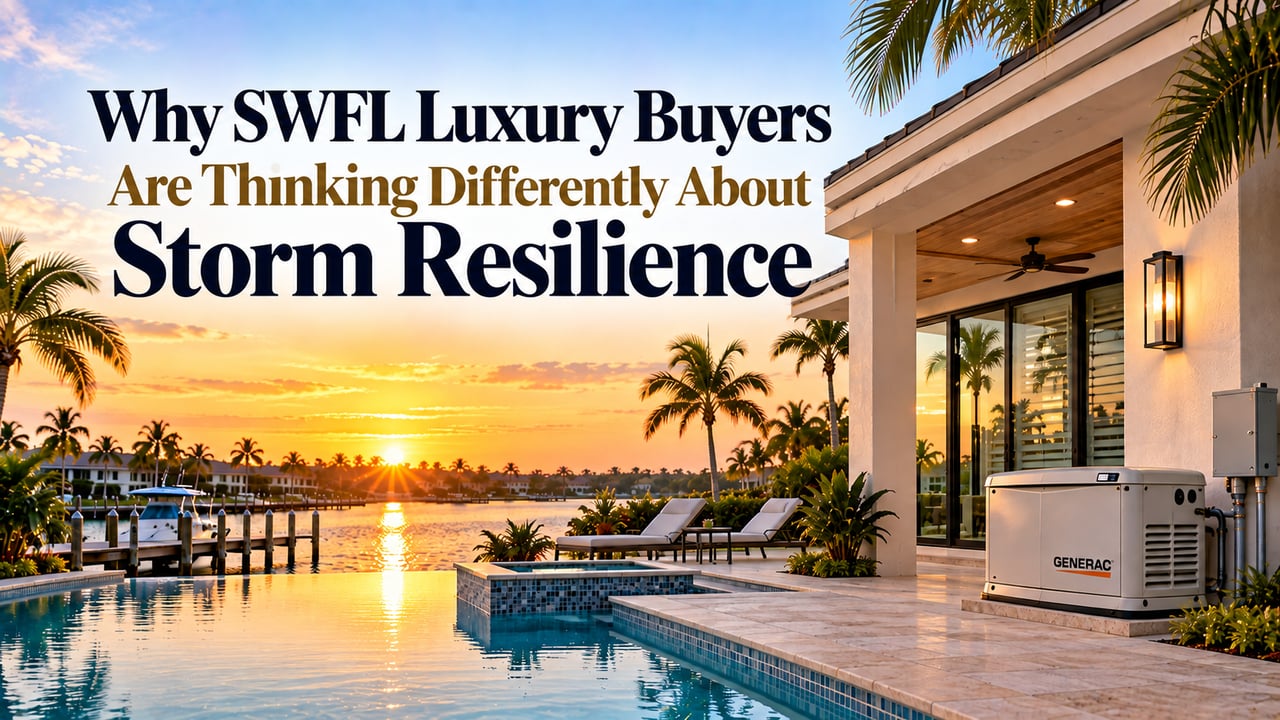
Luxury buyers in Southwest Florida are doing something different today than they were five years ago: they are making storm resilience a primary purchase criterion, not an afterthought. The homes and communities that deliver on it are seeing stronger demand and stronger values — and buyers who do not understand these features before they shop are making decisions with incomplete information.
The Shift Happened — and It Is Not Going Back
For most of Southwest Florida's real estate history, buyers treated storm risk as a background consideration — something to acknowledge, insure against, and move on from. The home was beautiful, the location was right, and the rest was paperwork. That calculation has changed meaningfully over the past several years, and the change is visible in how luxury buyers behave from the first conversation.
Buyers arriving in Naples, Fort Myers, and Bonita Springs today — especially those relocating from the Northeast or Midwest, or those purchasing second homes in the SWFL luxury market — come with a level of storm-preparedness awareness that previous buyer generations simply did not have. They have done the research. They have talked to friends and family who own in Florida. They have watched news coverage of major storms and paid attention to what happened to different types of properties. And they are asking questions about storm resilience before they ask about the kitchen or the pool.
As a luxury specialist throughout Lee and Collier County, I work with buyers across the full spectrum of SWFL's waterfront and golf communities — from Port Royal and Pelican Bay in Naples to Gulf Harbour Yacht and Racquet Club in Fort Myers to Bonita Bay in Bonita Springs. The pattern is consistent across all of them: storm resilience features now drive real purchase decisions, and their absence creates hesitation that price reductions alone cannot always overcome.
What Luxury Buyers Are Actually Evaluating
Understanding what buyers are looking at — and why — helps both buyers who are shopping and sellers who want to position their home effectively in today's market.
Impact-Rated Windows and Doors
Impact-rated windows and doors are no longer an upgrade in the SWFL luxury market — they are a baseline expectation. Buyers who encounter a luxury home still fitted with traditional windows and storm shutters treat it as a condition flag. The installation cost of retrofitting a luxury home with impact systems is significant enough that buyers factor it into their offer or walk away. Sellers who have not made this upgrade in communities where it is now standard are pricing themselves out of the conversation with informed buyers.
The difference matters not just for storm protection but for everyday living: impact windows reduce noise, improve energy efficiency, and eliminate the scramble to shutter before a storm. Buyers in the luxury tier understand all of this, and they weigh it accordingly.
Whole-Home Generator Systems
The ability to remain fully functional — air conditioning running, refrigerator cold, lights on, security system active — for days or weeks after a major storm without relying on grid restoration has become a significant differentiator in the luxury market. Liquid propane whole-home generators sized to run the entire home, not just a few circuits, are increasingly standard in new luxury construction and are one of the features buyers specifically ask about in resale properties.
In communities like Pelican Bay, where the community infrastructure itself is exceptionally well maintained, buyers still want to know the individual home can sustain itself independently of the broader grid. In more spread-out luxury communities, the question is even more pointed. A home without a whole-home generator is increasingly perceived as incomplete in the luxury segment, particularly at higher price points.
Roof System Age and Construction
Roof condition has always been a due diligence item in SWFL real estate. It has become a much more significant one in recent years as the insurance market has responded to storm losses by scrutinizing roof age and construction more carefully. A roof over 10 to 12 years old — regardless of how it looks from the outside — raises insurance questions that directly affect a buyer's ability to obtain coverage and their cost to do so.
Luxury buyers and their agents are now reviewing roof documentation alongside inspection reports. The material matters: metal roofs tend to perform better in storms and age better in SWFL's climate than tile in some configurations. The installation method matters. And the age matters enormously — a five-year-old roof and a fifteen-year-old roof on otherwise identical luxury homes produce meaningfully different insurance conversations.
Elevation and Flood Zone Position
Elevation above base flood level is one of the clearest predictors of both storm flooding risk and insurance cost in SWFL. Luxury buyers are reviewing elevation certificates before making offers and obtaining insurance cost projections as part of their due diligence, not after closing. The difference in annual insurance cost between a home elevated four feet above base flood level and one at base flood level can be substantial — and in communities like Port Royal, where homes sit at varying elevations along the waterfront, this distinction is now a real part of buyer conversations.
Flood zone designation matters as well. Buyers are learning to read FEMA flood maps and are making location decisions that reflect flood zone differences within the same community. A luxury agent who cannot explain flood zone implications is not fully equipped to serve a buyer in today's SWFL market.
Community Infrastructure and Historical Storm Performance
Beyond the individual home, buyers are evaluating the community itself. Communities with underground utilities perform differently during and after storms than those with overhead power lines. Communities with modern drainage infrastructure, recent capital improvements, and active HOA boards that maintain common areas consistently outperform those that have deferred maintenance. And communities that have a documented track record of recovering quickly after major storms — restoring amenities, clearing debris, getting residents back to normal life faster than surrounding areas — have a real and demonstrable advantage that buyers are learning to ask about.
In Bonita Bay, for example, the community's infrastructure investment and HOA management quality are part of what buyers are purchasing alongside the individual home. The same is true in Pelican Bay, where the community's private beach facilities, tram system, and maintained landscaping represent significant ongoing investment that buyers factor into their value assessment. The community story is now part of the storm resilience story.
How This Affects Pricing
The practical result of all of this is that storm resilience features now carry measurable premium value in the SWFL luxury market. A home that checks every box — impact systems, whole-home generator, newer roof, favorable elevation, strong community infrastructure — sells faster and at a stronger price than a comparable home that falls short on these criteria. The gap has been widening as buyers become more informed and the insurance market makes the cost implications more visible.
For sellers, the message is straightforward: investments in storm resilience are among the highest-return improvements you can make before listing in today's SWFL luxury market. For buyers, the message is equally clear: understanding these features before you shop — not after you fall in love with a home — leads to better decisions and fewer surprises.
The Buyer Protection Guarantee: If you're not happy with your home within 24 months of closing, I'll list and sell it for just 1% commission. No catches. Learn more at theabreugroup.com/buyer.
Ready to make your move in Southwest Florida? Let's talk.
Whether you're buying, selling, managing an estate, navigating a divorce, or just want a straight read on the market — I'm here.
Call or text: 727.638.1704
Email: [email protected]
Website: theabreugroup.com
— Daniel
Frequently Asked Questions
Q: How much does storm resilience affect luxury home insurance costs in SWFL?
Significantly. The difference in annual insurance cost between a fully storm-resilient luxury home and one that is not can run into thousands or even tens of thousands of dollars per year, depending on the property's value and specific features. Impact windows, roof age and material, elevation, and flood zone designation all directly affect premium pricing and carrier availability. Getting a real insurance quote — not an estimate — before making an offer is essential due diligence in today's Florida insurance market.
Q: Are there SWFL luxury communities known for stronger storm resilience?
Yes. Communities with underground utilities, newer infrastructure, strong HOA management, and consistent capital investment in common areas tend to perform better during and after storms. Pelican Bay and Bonita Bay are examples of communities where the HOA's infrastructure investment is part of what buyers are purchasing. Specific performance varies by storm, but there is meaningful variation across communities that experienced buyers and agents can speak to.
Q: What storm resilience features have the strongest return on investment for sellers?
Impact windows and doors, whole-home generator systems, and roof upgrades (where the existing roof is aging) tend to have the clearest impact on both marketability and pricing. The ROI calculation depends on what buyers in your specific price range and community are expecting. A luxury agent who is active in your community can give you a specific read on what buyers are asking for and what is most likely to move the needle on your sale.
Q: Does storm resilience matter more for waterfront luxury homes than non-waterfront?
Waterfront properties — and particularly gulf-front and canal properties with direct water exposure — face the highest storm risk and are subject to the most scrutiny from both buyers and insurers. But storm resilience features matter throughout the SWFL luxury market, not only at the waterfront. A luxury home five miles from the coast still needs a strong roof, good elevation, and ideally a whole-home generator to meet current buyer expectations in the luxury tier.